Barenboim and new music: three tenures, one loyalty
What we remember of him are the Beethoven sonatas, the Wagner operas, the three complete Bruckner cycles, the almost philosopher-pianist of the Mozart piano concertos. The collective imagination has, over time, settled on a single figure: Daniel Barenboim, custodian of the great Germanic repertoire, heir to Furtwängler, a Mozartian by election. That image, accurate but incomplete, has obscured one of the most singular dimensions of his career — a commitment of nearly fifty years to the music of his own time, whose coherence is matched only by its media discretion. More than thirty world and American premieres at the head of the Chicago Symphony Orchestra alone; two operas premiered in Berlin; commissioned symphonies in Paris and Chicago: few purely interpretive conductors of his stature have, over nearly half a century, integrated the music of their time as a structural component — rather than a decorative one — of their leadership of three great orchestras directed in succession.
Two dates are enough to grasp its scope. Paris, Palais des Congrès, June 18, 1980: the Orchestre de Paris gives the world premiere of Pierre Boulez's Notations I–IV, a commission from its principal conductor to the composer who, against all expectation, agreed then to take up piano miniatures from his youth and turn them into a monumental orchestral work. Chicago, Orchestra Hall, January 14, 1999: the same conductor premieres Notation VII with the Chicago Symphony Orchestra, nineteen years after the first four, on two continents and under the same founding gesture. The adventure of the orchestral Notations — left unfinished at Boulez's death in 2016 — would probably never have existed without that initial commission. The thread runs through Barenboim's entire career.
Paris, 1975–1989: the shaping of a taste
Appointed at 33 to succeed Solti, Barenboim undertook at the Orchestre de Paris the longest tenure the ensemble has ever known, along with a contemporary-programming policy of rare coherence. The record speaks for itself: several world premieres — Pierre Boulez's Notations I–IV (Palais des Congrès, June 18, 1980), Edison Denisov's Symphony No. 1 (a commission for the orchestra's twentieth anniversary, 1987), Hans Werner Henze's Fandango, Jacques Lenot's Pour mémoire III — and a systematic body of French premieres, notably of Henze and Lutosławski. To which is added a sustained engagement with the great voices of the late twentieth century: Berio, Xenakis, Dutilleux. No spectralists; Barenboim's "Parisian" modernity is deliberately international and embraces an editorial parity among Central Europe, France, and Germany. Boulez is not merely a composer performed: he is, by Barenboim's own account, the initiator who revealed Schoenberg, Berg, and Webern to him, and a regular institutional partner — the two-orchestra concerts bringing together the Orchestre de Paris and the Ensemble intercontemporain established a circulation between repertoire and new music that existed nowhere else on such a scale.
Three discographic milestones fix this period. The coupling of Notations 1–4 / Rituel in memoriam Bruno Maderna / Messagesquisse by Boulez, released on Erato, records the premiere of the Notations — a founding gesture whose importance is not always appreciated: it is Barenboim, not Boulez, who premieres Boulez's pieces orchestrally. The composer-conductor chose a relay interpreter, in the house that was then defending contemporary French music most systematically. The Symphonies No. 1 and No. 2 Le Double by Dutilleux, recorded in 1988 for Erato, place Barenboim in the lineage of Munch and durably install the composer in the great twentieth-century orchestral repertoire, at a moment when his work was far from canonized. Finally, Denisov's Symphony No. 1, recorded on Erato in 1991, documents a commission whose significance owes as much to the quality of the work as to the figure of its author — the most Francophile of the Russian composers of his generation, settled in Paris at the end of his life, and today, sadly, quite forgotten.
The abrupt departure from the Opéra-Bastille in 1989 — Pierre Bergé dismissing the conductor a few months before the inauguration — closes this Parisian sequence on a rupture whose cultural reckoning has never truly been drawn.
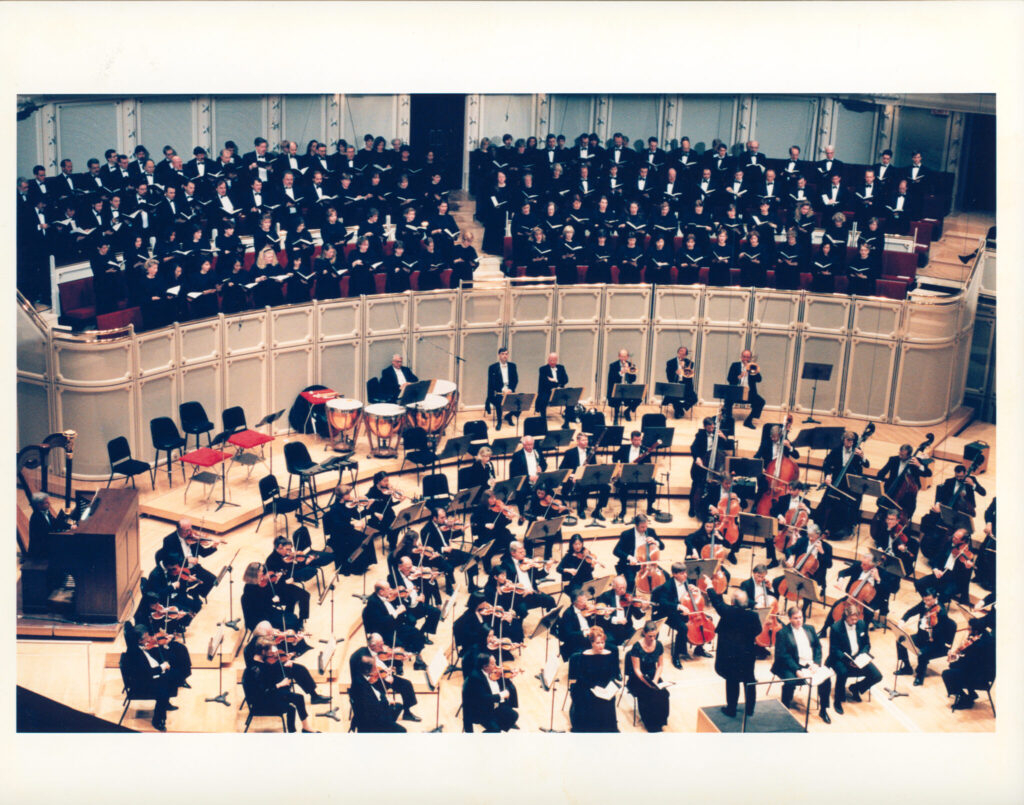
Chicago, 1991–2006: the commissioner
In the United States, the angle shifts radically. At the head of the Chicago Symphony Orchestra, Barenboim is no longer merely a programmer: he becomes a systematic commissioner. The CSO machine, inherited from a Solti at the height of his instrumental power, is placed in the service of a commissioning policy that produced, in fifteen years, more than thirty world and American premieres — a figure no American music director of the period comes close to.
The list is impressive: Stephen Kowalsky, Last Voyage (September 1990); John Corigliano, Symphony No. 1, a commission for the CSO's centenary; Elliott Carter, Partita (February 17, 1994); York Höller, Aura (October 1995); Aribert Reimann, Violin Concerto with Gidon Kremer (May 1997); Harrison Birtwistle, Exody (February 1998); Pierre Boulez, Notation VII (January 1999); Augusta Read Thomas, Ceremonial (January 2000); Hanspeter Kyburz, Noesis (Lucerne, September 2001); Bernard Rands, apókryphos (May 2003).
The discographic pivot of the period is the Teldec recording made between 1993 and 1994, which couples three CSO world premieres: Carter's Partita, Berio's Continuo, and Takemitsu's Visions — Berio and Takemitsu captured on the same day at Orchestra Hall, January 9, 1993; Carter recorded in June 1994 at the Kölner Philharmonie during a European tour, a sign that the recording project was built over time. Released in 1995, the triptych stands as a manifesto: three aesthetics irreconcilable on paper — Carter's dense aphorism, Berio's continued vocal gesture, Takemitsu's suspended breath — a single orchestra, and a conductor who never sets repertoire against new music.
Berlin, 1992–2023: institutionalization
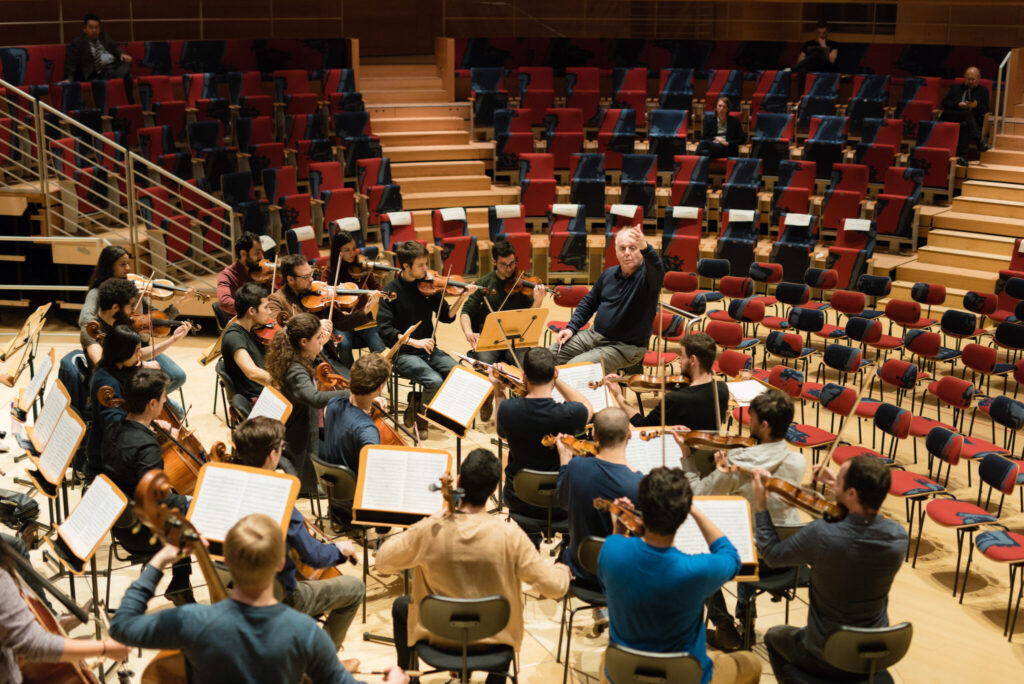
The center of gravity tips toward opera and Germanic modernity, but with a contemporary summit that is a genuine historiographical bombshell: the world premiere of Elliott Carter's only opera, What Next?, on September 16, 1999, at the Staatsoper Unter den Linden, the composer then aged 90; and that of Harrison Birtwistle's The Last Supper on April 18, 2000, a tripartite co-commission from the Staatsoper / Glyndebourne / South Bank Centre. These two premieres alone would suffice to secure Barenboim a place in the history of contemporary opera.
The Birtwistle companionship in fact extends over twenty years, from the Chicago Exody of 1998 to the Berlin Deep Time of 2017 with the Staatskapelle — a through-line that consolidates the idea of a Chicago–Berlin continuity rather than a break. Barenboim's appointment in 2000 as conductor for life of the Staatskapelle institutionalizes this policy. A less-noticed but equally systematic loyalty develops with Jörg Widmann: Barenboim has performed with the Staatskapelle the entirety of his major symphonic works and programs at least one of his compositions every year. It is he, too, who commissioned Widmann for the revised version of Babylon, presented at the Staatsoper in March 2019 — an opera he would ultimately have to hand over to Christopher Ward for health reasons, but which he had shepherded from beginning to end in its conception.
The inauguration of the Pierre Boulez Saal on March 4, 2017, within the walls of the Barenboim-Said Akademie, is its architectural and programmatic culmination. The gesture is rare: a working conductor dedicates to one of his peers a concert hall bearing his name, designed by Frank Gehry and acoustically tuned by Yasuhisa Toyota. But it is no mausoleum. The artistic project, placed under the motto Music for the Thinking Ear, makes the dialogue between repertoire and new music the very principle of the programming — about one hundred and fifty concerts a season, where twentieth-century classics and world premieres share the bill with Beethoven, Schubert, and the music of the Arab world. The Boulez Ensemble, founded by Barenboim for the house, is the active cell of this policy: its programs systematically pair a classical or Romantic piece with a work of the twentieth or twenty-first century.
Its most striking example is surely the Festival of New Music co-curated with Emmanuel Pahud in July 2020, at the height of lockdown. Four days, ten world premieres by a new generation — Irini Amargianaki, Benjamin Attahir, Johannes Boris Borowski, Luca Francesconi, Michael Jarrell, Philippe Manoury, Olga Neuwirth, Matthias Pintscher, Christian Rivet, Jörg Widmann — all streamed free online, with the entire body of musicians and composers working pro bono in solidarity with the artists struck by the pandemic. Each concert opened with a work by Boulez. The effort is at once an aesthetic manifesto and an ethical gesture: when the concert collapses, the commission goes on. Few institutions managed to hold this double wager with such clarity.
A cartography in negative
It remains to say what Barenboim never conducted. No Ferneyhough, no Sciarrino, no Grisey or Murail — the avoidance of French spectralism is almost structural, even as he was leading the Orchestre de Paris at the very moment when L'Itinéraire and Grisey's first scores were taking hold a few kilometers away. No Lachenmann on his podium either, even if the Pierre Boulez Saal welcomes him through other ensembles. His modernity stops at a specific generation — that of Boulez, Berio, Carter, Dutilleux, Denisov, Henze, Birtwistle, Corigliano, Rihm — broadened by the names he championed in Berlin and at the Pierre Boulez Saal (Widmann above all, but also Neuwirth, Pintscher, Manoury). The most radical terrain of the post-1970 era — notational complexity, spectralism, the deconstruction of instrumental sound — remains out of frame. This limit is not a flaw: on the contrary, it traces a perfectly assumed taste, that of a conductor for whom the music of his time is inseparable from a certain continuity with the great Germanic and French orchestral tradition.
And that is perhaps his ultimate singularity. Where his contemporaries who specialized in new music shut themselves inside the repertoire of their own generation, Barenboim, in one and the same gesture, conducted Bruckner and premiered Carter, revived Tristan and commissioned Denisov, streamed Widmann under lockdown. New music as the natural extension of the great repertoire, and not as a separate territory. A conception that today seems under threat — and of which today's article might, perhaps, be the discreet elegy.
Exhaustive name-by-name list in Frank Villella, "Daniel Barenboim @ 75: World and U.S. premieres," blog of the Rosenthal Archives of the Chicago Symphony Orchestra, November 3, 2017 (csoarchives.wordpress.com).
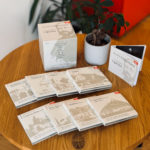
Five discographic points of entry
— Boulez, Notations 1–4 / Rituel / Messagesquisse, Orchestre de Paris, Erato, 1990
— Dutilleux, Symphonies Nos. 1 and 2, Orchestre de Paris, Erato, 1988
— Denisov, Symphony No. 1, Orchestre de Paris, Erato, 1991
— Corigliano, Symphony No. 1, Chicago Symphony Orchestra, Erato, 1991
— Carter / Berio / Takemitsu, Partita / Continuo / Visions, Chicago Symphony Orchestra, Teldec, 1995
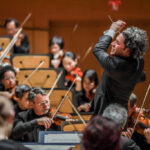
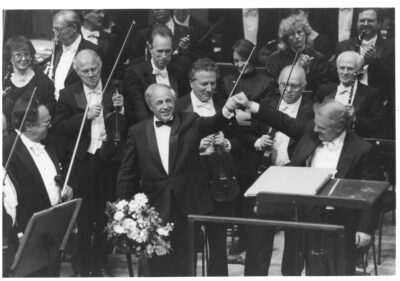
Photo credits: Jim Steere photo, courtesy of the Rosenthal Archives of the Chicago Symphony Orchestra / Peter Adamik
Traduction : Claude IA