Dudamel Leaves Los Angeles: Anatomy of a Global Brand
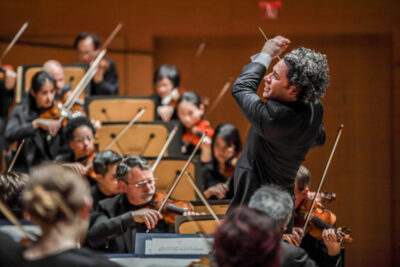
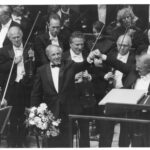
On June 7, 2026, at Walt Disney Concert Hall, Gustavo Dudamel brought seventeen seasons at the helm of the Los Angeles Philharmonic to a close. The scene is a familiar one: a standing ovation, a sold-out house, "Gracias Gustavo" banners along Grand Avenue, Antonio Estévez's Cantata Criolla to close — the very work he had made a point of programming on his first vocal-music program back in 2010, the ritual closing of a founding narrative. But that Sunday, Mark Swed of the Los Angeles Times noted a detail that ran against the staging: on several occasions, when the conductor asked the orchestra to rise and share in the bows, the musicians declined. Dudamel insisted, took the concertmaster by the arm; the latter sat back down the moment the pressure eased. The conductor, Swed wrote, looked taken aback. The episode lasted several minutes.
One can read it as a silent tribute — this moment is yours, not ours — or as the quiet self-assertion of a collective reminding everyone, beneath the glow of the banners, that it exists apart from its conductor. Both readings coexist, and it is precisely that ambiguity that makes any assessment of Dudamel less seamless than the official messaging would suggest. We will come back to it at the end. It takes on its full meaning only once one has understood what Dudamel was, for seventeen years, to this house.
The "Added Value" Mandate
To begin, we need to set out a framework that criticism tends to lack. The role of music director of a major orchestra, as it has been practiced since Simon Rattle in Berlin (2002–2018), is no longer the same as it was under Karajan or Bernstein. Yet we continue to evaluate conductors by criteria inherited from the previous era — discography, tours, mastery of the canon — even though the position has redefined itself around a different equation, one we might call added value: what the mandate produces beyond the purely musical, measured in territorial rootedness, structural educational programs, digital reach, global visibility, expanded media circulation, and innovative contractual arrangements.
Rattle did not invent the model — Salonen had sketched it out in Los Angeles as early as the 1990s, with Walt Disney Concert Hall delivered in 2003, the Green Umbrella series as a laboratory, and the repositioning of the orchestra as a player in contemporary Californian culture — but he consecrated it by planting it in Berlin, that is, in the institution that, more than any other, defines what a music director's mandate is in the collective imagination. The Digital Concert Hall (2008), the Zukunft@BPhil program, the overhaul of educational policy: without Berlin, the model would have remained "Californian," easily marginalized; with Berlin, it becomes the contemporary model, one against which every other orchestra can be measured.
Dudamel arrives in Los Angeles in 2009 on this prepared ground, and he carries the model to its maximum. It is through this lens that what follows should be read, before we return to the strictly musical assessment: because in this generation of conductors, he is perhaps the only one to have tipped the function itself into a category that neither the classical world nor criticism had anticipated — that of the global brand.
A Conductor, a Twenty-First-Century Brand
The word is loaded for a music-loving readership, and it needs to be defused straightaway. "Brand" here is not a term of derision, and it does not reduce Dudamel to a commercial operation. It designates a sociological category — in the sense in which Bourdieu might speak of circulating symbolic capital, or Boltanski of a reputational asset: something an institution builds, protects, transfers, monetizes. At that level, only three or four people per generation exist in the classical field. Karajan was one. Bernstein was one. Yuja Wang is one today, more or less alone in the instrumental world. And Dudamel is one, more or less alone among conductors.
The degree of cultural penetration is measurable. The broad, non-specialist public knows Dudamel the way its elders knew Karajan or Bernstein — by the hair, the smile, the gestural silhouette, the star on the Hollywood Walk of Fame awarded in 2019, the cameo in Trolls World Tour in 2020, the Hollywood Bowl collaborations with Billie Eilish, Christina Aguilera, and Ricky Martin. The character of Rodrigo de Souza in the series Mozart in the Jungle (Amazon, 2014–2018, four seasons, Golden Globes 2016) is explicitly modeled on him — the hair, the gestures, the Latin American accent, the El Sistema background. To inspire a character in a scripted drama across four seasons is a degree of cultural penetration no living conductor has achieved since Bernstein — the fact deserves to be weighed for what it is: a sociological fact without equivalent.
This construction has several founding moments, which mark out nearly the entire Californian sequence.
The first is the halftime show of Super Bowl 50, on February 7, 2016, in Santa Clara — Coldplay, Beyoncé, Bruno Mars, and Dudamel on the podium, surrounded by the children of YOLA, before a little over one hundred and ten million American viewers and a considerable global audience. The first classical conductor in history to appear at a Super Bowl halftime show. The scene is saturated with signs: the baton held by a Venezuelan alongside a pop singer performing Formation on the very day the track was released, children from the Latino communities of Los Angeles, the institutional banner of the LA Phil planted in the very heart of the American sporting ritual. This is the moment that seals the fusion of the orchestra, its conductor, its educational project, and global pop culture.
Then comes, mid-decade, the pivotal moment: Steven Spielberg's West Side Story (December 2021). Dudamel conducts the film's score — orchestrated by David Newman, supervised by John Williams — recording eighty percent with the New York Philharmonic at the Manhattan Center in 2019, then twenty percent with the Los Angeles Philharmonic at the Newman Scoring Stage in 2020, after the pandemic shutdown. The film earns seven Oscar nominations in 2022 and two statuettes. In hindsight, it is in the New York session that the most discreet signal lies: three years before the official announcement of February 2023, Dudamel is already conducting Bernstein's orchestra in Bernstein's emblematic score. West Side Story is not only the brand's Hollywood moment; it is, though no official communication says so, the dress rehearsal for bicoastality.
Two closely spaced markers follow. In September 2021, the Disney+ concert film Happier Than Ever: A Love Letter to Los Angeles, with Billie Eilish and FINNEAS, captured at the Hollywood Bowl, is streamed worldwide. In March 2022, Theodore Braun's documentary ¡Viva Maestro! opens in theaters and then on Amazon and Apple TV — the conductor himself becomes a distributed cinematic object.
The second founding moment is Coachella, on April 12 and 19, 2025 — during the "Gracias Gustavo" season, which is not incidental. The Los Angeles Philharmonic becomes the first major symphony orchestra to headline the Indio stage. The programming director, Meghan Umber, would speak of "Gustavo's mixtape." The orchestra crosses the California desert by bus, plays for an hour before the festival crowd, and blends Vivaldi–Richter with pop guests — LL Cool J rapping Rock the Bells over the opening chords of The Firebird, Dave Grohl singing Everlong in symphonic garb, Cynthia Erivo, Laufey, Becky G, Natasha Bedingfield, Zedd, Ca7riel & Paco Amoroso. The remark by Bing Wang, associate concertmaster, in the local press — that she had never set foot in Coachella before leading her orchestra there — says it all: this is not an orchestra jumping on the pop bandwagon, it is an orchestra whose conductor-brand authorizes such a crossing without anyone in the house batting an eye.
In 2025, a final object comes to close the construction and give it its definitive status. El canto de las manos (Song of the Hands) is the first film by María Valverde, the conductor's wife since 2017, a Spanish actress who won a Goya at sixteen, discovered by Manuel Martín Cuenca and later directed by Ridley and Jordan Scott. The film follows the preparation, by the Coro de Manos Blancas — a Venezuelan choir of deaf and hard-of-hearing musicians — of a production of Fidelio in sign language, carried by the Dudamel Foundation. It enters competition at DOC NYC 2025, travels to Guadalajara and Morelia, opens at Disney Hall with a conversation moderated by Ava DuVernay featuring Dudamel, Valverde, and DJ Kurs of Deaf West Theatre, and is then presented by the couple at the 44th edition of Montreal's FIFA in March 2026, with Rafael Payare in attendance. It is no longer the brand circulating within pop culture; it is the brand producing its own cultural object, and circulating it within the auteur-festival circuit — the very one that might have resisted a commercial reading of the figure.
No living conductor has built a device of this kind. One has to go back to Bernstein to find a couple of artists in which one stages the other's work in an award-winning object — and even Bernstein and Felicia Montealegre never crossed that threshold. Dudamel–Valverde is sui generis, and the film that gives this couple material form accomplishes three functions simultaneously, which we will come to understand are inseparable: it legitimizes the brand within the most demanding artistic field; it adds to the apparatus a familial capital that most contemporary conductors lack; and it allows Dudamel to keep speaking about Venezuela — but from a depoliticized humanist standpoint, that of disability and universal music. It is perhaps, in the entire sequence, the subtlest gesture.
Between Santa Clara in 2016 and Montreal in 2026, the Los Angeles Philharmonic accomplished, under Dudamel's direction, what no major American orchestra had dared: it turned its conductor-brand into a global cultural asset — monetizable, transferable, able to operate at Disney Hall, in Caracas, in Santa Clara, in Indio, and at DOC NYC alike. The house invested in the brand as much as the brand invested in the house.
The Condition That Makes It All Possible: Seventeen Seasons
A construction of this density is possible only over the long term, and this is perhaps what most radically distinguishes Dudamel from all his contemporaries. It has to be measured against today's standards.
With the exception of Rattle in Berlin (2002–2018, sixteen years, already perceived in its time as an exceptionally long tenure), the music directors of the current working generation rarely hold their post beyond eight to ten years: Nelsons in Boston will have twelve by the end of 2026; Nézet-Séguin in Philadelphia will have fourteen, but with the Met running in parallel since 2018; Petrenko in Berlin is entering his seventh; Salonen left San Francisco after five years over a budget dispute; Van Zweden in New York stopped at six.
Long tenures — fifteen years or more, without interruption and without being split across several houses — have become the exception. Dudamel, at seventeen consecutive seasons, is therefore, among the generation of conductors now in their fifties, a case unto himself. The contemporary norm has become that of the itinerant conductor, who moves among four or five posts, leads two or three orchestras at once, and signs for short terms.
This longevity is not incidental. It is what made possible the construction just described. A conductor-brand is not manufactured in six years; it requires the slow time of media sedimentation, the repetition of headline moments, the building of loyalty from an audience and a territory. That is what the seventeen Californian seasons made possible — and what sets the Dudamel case apart from all his working peers.
What the Brand Made Possible, and What It Left Fallow: The Discography
Once the brand is understood, the musical assessment becomes legible for what it is — not a mere inventory of recordings, but the sedimentation of strategic choices that translate the territorial and identity-based rootedness of the project.
The Californian narrative consolidates everything into a single block: seventeen seasons, sixty-two premieres personally conducted, thirty commissions through the Pan-American Music Initiative, a Mahler Project running simultaneously in Los Angeles and Caracas in 2012, a Mozart/Da Ponte trilogy staged with Frank Gehry and Rodarte, a Wagner cycle begun with Das Rheingold (2024) and continued with Die Walküre (May 2026). The story is massive, and it is partly accurate.
Mahler remains the most visible arc — from the first DG recording, the Ninth taped in 2009 upon his taking office, to the Resurrection that opens the "Gracias Gustavo" season in October 2025, by way of the Eighth (DG, 2021), which took the Grammy for Best Choral Performance. But the discography did not retain the edge of the Californian evenings: the Eighth remains a prestige object without imposing itself in the line of the work's canonical references — Solti/Chicago (Decca, 1971), Bernstein/Vienna Philharmonic (DG, 1975), Abbado/Berlin (DG, 1994).
It is in the American and contemporary repertoire that the LA Phil/Dudamel recordings truly assert themselves and cut the clearest furrow: Andrew Norman's Sustain (DG, 2019, Grammy for Best Orchestral Performance), the symphonies of Charles Ives (DG, 2020, Grammy), Thomas Adès's Dante on Nonesuch (2023, Grammy 2024), Gabriela Ortiz's Revolución diamantina on Platoon (2024, three Grammys), not to mention John Adams's The Gospel According to the Other Mary (DG, 2013) and the concertante diptych with Yuja Wang — Adams (Must the Devil Have All the Good Tunes?, 2020), then a complete set of the Rachmaninov concertos (DG, 2023).
The Austro-German canon almost entirely escaped the LA Phil discography. Beethoven symphonies: no recording with this orchestra — the complete set exists, but with the Simón Bolívar, self-produced in 2017. Bruckner: no disc either, despite a handful of concerts regarded as memorable. Brahms: the Fourth Symphony (DG, 2011), which in fact won Dudamel's very first Grammy for Best Orchestral Performance, without any symphonic cycle ever being undertaken. Neither the Dvořák 7–9 (DG, 2022) nor the Nutcracker (DG, 2018) proved any more significant.
The verdict is coherent, but it is not neutral: in Los Angeles, Dudamel signs the discography of an American orchestra, about America, for America. This is not a flaw, it is a choice — consistent with the construction of the brand we have just analyzed. A house that wants to weigh on global culture in 2020 no longer measures itself against the Austro-German canon, where the differential with Berlin, Vienna, or Amsterdam is structurally unfavorable; it invests where it can invent a balance of power — the American repertoire, contemporary Latin American music, systematic commissions. As for the sixty-two premieres personally conducted and the thirty Pan-American Music Initiative commissions, few have entered the standing repertoire of other American orchestras — the question of their real posterity remains open, independently of the Grammys and Latin Grammys that consecrated their immediate visibility.
YOLA: The Anchor That Makes the Rest Possible
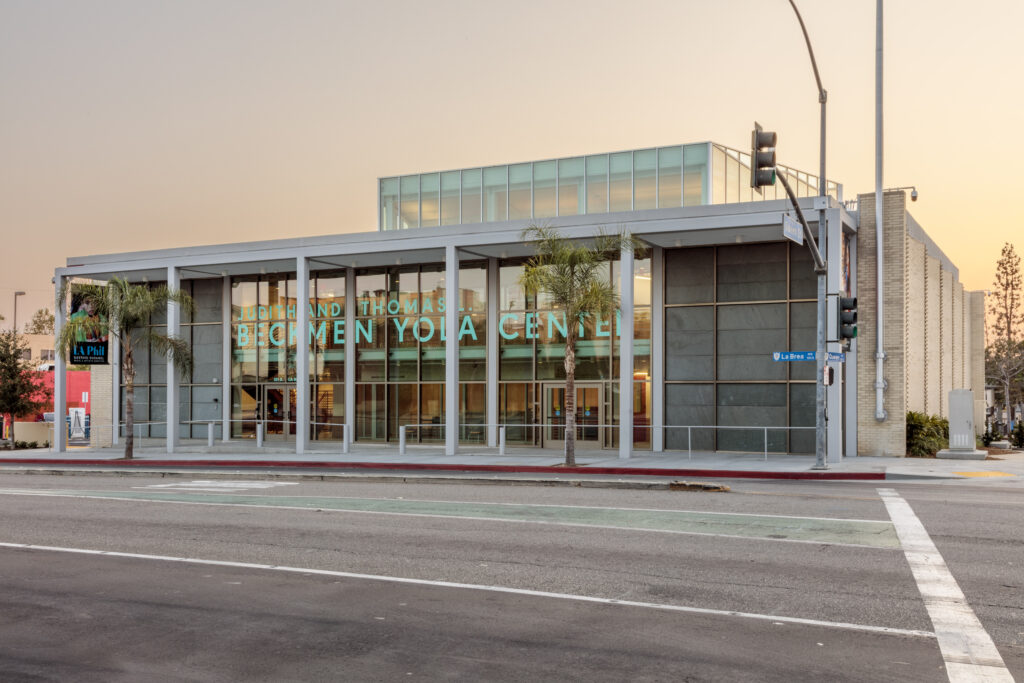
This is probably the point on which the assessment is most solid, and it is also the local pillar without which the global circulation of the brand would have had no credibility. The Youth Orchestra Los Angeles, founded in 2007 with eighty children, today welcomes roughly one thousand seven hundred across four sites, and since October 2021 has had a dedicated building designed by Gehry — the Judith and Thomas L. Beckmen YOLA Center, in the Inglewood district. Institutional continuity, sustained funding, pedagogical quality attested by successive cohorts: all of this exists.
Without YOLA, Coachella and the Super Bowl would have been perceived as free-floating operations. YOLA provides the proof of territorial and political credibility that makes the global media circulation legitimate — it is because there are one thousand seven hundred children in Inglewood that the baton at Levi's Stadium cannot be reduced to a communications stunt. The anchor produces the circulation, the circulation enhances the anchor: it is a two-stage system that other American orchestras have been able to observe but rarely to reproduce.
What remains is to name what the Californian narrative leaves unsaid. YOLA gradually emancipated itself from its ideological matrix, the Venezuelan El Sistema, as the critical work of Geoff Baker (El Sistema: Orchestrating Venezuela's Youth, Oxford University Press, 2014; then Rethinking Social Action through Music, 2021) dismantled — archives and testimonies in hand — the myth of a purely emancipatory social program. Dudamel's public break with Nicolás Maduro, in May 2017, after the death in Caracas of the young violist Armando Cañizales during a demonstration, came late and after several years of strategic silence. LA Phil communications now mention El Sistema only through the tutelary figure of José Antonio Abreu — never through its political prolongations under Chavismo. This discreet dissociation is an act of image management whose honest history will, one day, have to be written.
It is here that El canto de las manos takes on its full scope. The film makes it possible to keep El Sistema as an emotional heritage — the Coro de Manos Blancas is a pure product of it, these are its children — without having to bear its political burden, because the film's apparatus shifts the narrative entirely onto the humanist and aesthetic plane: disability, universal music, the private Dudamel Foundation, Beethoven, Fidelio as the opera of liberation. Venezuela appears in it, but depoliticized, reduced to a backdrop of artistic generosity. It is probably not a conscious and cynical operation — Valverde surely believes in it, Dudamel surely believes in it — but structurally it is an operation of re-narration that fills precisely the ideological slot left empty by the dissociation from Chavismo. It is the subtlest gesture of the sequence because there is no contradiction between the sincerity and the strategic function: there is convergence.
The Harding Choice: Corrective or Continuation?
The announcement, in May 2026, of Daniel Harding as the twelfth music director of the Los Angeles Philharmonic is, in itself, a commentary on what the preceding reign was. Harding is not a conductor-brand, not a conductor–identity symbol; he is a musician of the European school, trained under Rattle and Abbado. The board chaired by Jason Subotky — with Kim Noltemy, who arrived as chief executive in July 2024, as second — explicitly chose not to reproduce the Dudamel model.
This decision comes in a context of internal fragility. Three of the four concertmasters — Martin Chalifour, Nathan Cole, Akiko Tarumoto — are leaving the orchestra at the end of the 2025/26 season. The section is being rebuilt at the same time as the artistic leadership. The trajectory Salonen → Dudamel → Harding, read as a single movement, tells the story of an orchestra that successively sought modernist legitimacy, global popular projection, and then a return to a musical authority grounded in mastery of the great Austro-German repertoire.
This choice has to be read for what it is. Los Angeles is not renouncing the "added value" model — YOLA remains, the contemporary programming remains, the Dudamel brand remains in laureate form — but it is explicitly asking for a corrective on the side of traditional musical authority, of the great repertoire absent from the discography, of canonical stylistic mastery. The Subotky–Noltemy board probably thinks, very rationally, that with the Dudamel brand now built, it can henceforth function autonomously — at Lincoln Center as at Disney Hall — and that a music director entirely devoted to the traditional functions can complement it without replacing it.
This is in reality a two-headed architecture for the house: the brand keeps circulating through Dudamel-Laureate, the traditional artistic side is restored by Harding as music director. It remains to be seen how the public will react.
The Post-Tenure Apparatus as an Asset-Preservation Strategy
Much has been made of the move to New York as a symbolic promotion — succeeding Mahler, Toscanini, Bernstein — and of the choice to open the 2026/27 season (Adams's On the Transmigration of Souls, on the twenty-fifth anniversary of September 11) as a memorial gesture. But what matters for the Los Angeles Philharmonic is not Dudamel's New York motivation. It is what the sequence reveals about the relationship he will have maintained, for seventeen years, with the orchestra he is leaving, and about the way that relationship extends beyond the tenure.
The honorary title of Diane and M. David Paul Artistic and Cultural Laureate, the contractual return of roughly four weeks a year to Disney Hall, the perpetual direction of YOLA: this is not a sentimental compromise, it is an asset-preservation strategy. The orchestra cannot afford for its most powerful brand to be extinguished abruptly at Lincoln Center. The brand will therefore keep circulating between the two coasts, like a shared symbolic capital.
The consequence for the house is direct. Daniel Harding will inherit an orchestra in which the predecessor returns regularly, in which the most visible educational project remains under his signature, in which a significant part of the institutional narrative continues to be written in his name — and in which the most recognizable brand in global classical music will shuttle between Disney Hall and David Geffen Hall. No American orchestra has truly succeeded, over time, in holding this balance between a weighty legacy and the intermittent presence of the predecessor. That is the test awaiting the Subotky–Noltemy–Harding team from September 2026.
What the Silence Says
The orchestra's gesture, that June 7, takes on its meaning here. A collective that refuses to rise when the conductor asks it to is no longer in a relationship of hierarchical dependence: it says, without saying it, that the sequence is truly ending. For seventeen years, the Los Angeles Philharmonic agreed to embody an artistic project but also a global-brand project. The Harding choice, the symbolic self-assertion of the final bows, the tacit dissociation from El Sistema: all of this indicates a house reclaiming itself.
Dudamel leaves Los Angeles what he genuinely built: YOLA, a global visibility, a decade and a half of programmatic audacity, a first-rank American discography, and a familial artistic ecosystem of which El canto de las manos is the most fully realized manifestation. He takes to New York what he has always been — a musician of very high emotional voltage, an exceptional communicator, a symbol. The question, from now on, is no longer that of his Californian record. It is whether, at Lincoln Center, without the Disney–Gehry–YOLA ecosystem that in Los Angeles made up half the narrative, the conductor can still be anything other than an icon.
More than thirty years ago, Norman Lebrecht announced in The Maestro Myth (1991) the collapse of the conductor-as-monarch model. What the Rattle–Salonen–Dudamel trio has shown is that it was not a collapse — it was a mutation. The conductor-monarch gave way to the cultural-entrepreneur conductor, with his strengths (institutional impact, audience expansion, global brands, active territorial rootedness) and his fragilities (overexposure, colossal financial demands, selection by personality, a brutal hierarchy between branded orchestras and brandless ones). Dudamel is perhaps, in this lineage, the most fully realized and purest case — the one who carried the model to its maximum, to the very point where the institution hosting him judged it necessary to remind everyone, through its choice of successor, that traditional music-making remained its raison d'être. This was not the end, Lebrecht said; it was the beginning of something else. We are now living through one of its first complete assessments. There will be others.
Photo credits: © Joshua White and Dustin Downing / @metakeaphoto