The Death of the Prince, the Birth of the Missionary: How Simon Rattle rewrote the job description of the music director
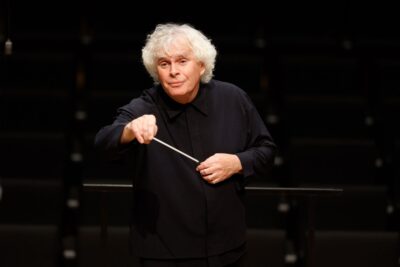
There is one image we keep of Simon Rattle: the mane of curls, the smile, the supple gesture, the air of a man who explains as much as he conducts. And there is another, quieter one, that may say more: a concert hall rising from the ground in Birmingham in 1991, Symphony Hall, because a conductor of thirty-six had decided that his orchestra deserved a home worthy of it. The whole man lies between these two images. For what Rattle built across forty years is not, first and foremost, a body of interpretations. It is a function. He redefined what a music director is — and, in doing so, killed off one idea of the profession to install another.
The Prince
To measure the break, we must recall what Rattle inherited. The music director, as the twentieth century had sanctified him, was a prince. From Toscanini to Furtwängler, from Karajan to Solti, the office came down to two sovereign gestures: to embody a sound and to reign over a repertoire. The conductor was a demigod, a verticality, a signature. Radio, then the record, then the image had forged that myth and raised it to incandescence — Karajan, stage-manager of his own legend, its culmination as much as its caricature. The prince answered to no one; his sole mission was to be great.
It was this figure that Rattle would render obsolete — not through polemic (he never theorised any act of killing) but through a simple shift of the centre of gravity.
The Birmingham Laboratory
We are inclined to locate the Rattle revolution in Berlin. That is a trick of perspective. It happened in the provinces, at the City of Birmingham Symphony Orchestra, where he stayed eighteen years, from 1980 to 1998 — very nearly a lifetime. And what he built there looks, at first, like the most classical of models. He takes a respectable regional orchestra and, over time, makes it a world-class ensemble — the very gesture of an Ormandy in Philadelphia or a Mravinsky in Leningrad. He secures, in 1991, the building of Symphony Hall, one of the finest halls in Europe. And he forges his artistic identity across a long discographic series on EMI, the way reputations were once built — record after record, patiently: his Sibelius and Mahler cycles, his Szymanowski, his Nielsen, that Turangalîla of Messiaen set down as early as 1987 with Peter Donohoe and still a benchmark. At first glance, a faithful heir to the Karajan model — one more prince, simply younger and more smiling.
But look more closely at that repertoire, and the reversal already shows through. What Rattle builds in Birmingham is also a laboratory of the twentieth century: where the prince maintained a canon, he manufactures a new one. New music is no ornamental afterthought, no short curtain-raiser slipped in before the serious business — it is the very substance of his project. He even endows the city with a purpose-built instrument, the Birmingham Contemporary Music Group, of which he is the founding patron in 1987 — an ensemble devoted solely to new work, on the model of Boulez's Ensemble intercontemporain. He turns Messiaen into a great-repertoire composer, records Henze, installs Mark-Anthony Turnage as the orchestra's first composer in association (1989-1993), and in 1997 premieres Asyla by a twenty-six-year-old Thomas Adès — the very score he would choose, five years later, to open his first concert as music director in Berlin, before Mahler's Fifth. The provincial discovery carried to the summit, like a manifesto.
For Asyla is no isolated case: Rattle championed a whole constellation of British composers, of opposing generations and aesthetics — the sprawling romantic fresco of Nicholas Maw, whose immense Odyssey he recorded in 1991; the fine craftsmanship of an Oliver Knussen; the music of Colin Matthews, whose …through the glass he premiered in 1994; and, at the far end of the temperamental spectrum, Turnage's jazz-inflected urban irony and the young Adès's feverish virtuosity. The parallel with the visual arts is irresistible: this is the very moment when creative England recovers its confidence, the moment of the Young British Artists, that insolent wave which, from Damien Hirst to Tracey Emin, reinvents English art and restores it to world centrality. Rattle is to the British music of those years what that movement was to the visual arts — not the creator, but the enabler: the one who gives a stage, a commission, an orchestra and a legitimacy to voices that were only waiting for them.
The project culminates in Towards the Millennium, a traversal of the century decade by decade throughout the 1990s: not one more festival, but a way of telling modernity as a continuous story, of turning the listener into an explorer rather than a worshipper. Rattle does not merely programme the new; he orders it, gives it a narrative, makes it necessary. And he constantly sets it against the great repertoire — a Henze against a Brahms, an Adès against a Mahler — that friction of the contemporary and the canonical that would become his signature. At the BBC Proms, that national tribune where musical England takes its own measure each summer, the rise of the CBSO finds its public vindication: the provincial orchestra becomes a national affair, and the young conductor, a figure.
This is precisely where the reversal lies hidden.
The Hinge
For Rattle embodies this model of the conductor-built-on-record at the very instant the record collapses. He is the last of one lineage and the first of another, and this hinge position is the key to everything. The last great conductor with an exclusive recording contract, he watches the industry that made him crumble beneath his feet — and becomes, during his Berlin tenure, one of the architects of the medium meant to replace it: the Digital Concert Hall, launched in 2008, which would be imitated the world over. To build oneself on a dying medium while fabricating its successor: the contradiction is not a weakness of the story, it is its heart. Rattle is not "first old, then modern"; he is both in a single movement, and that is what makes him revolutionary where others would have been merely transitional.
The Missionary
To the builder and the pathfinder of repertoire, Rattle adds everything the prince ignored. Pedagogy first, raised to a central mission rather than a moral obligation — a project begun in Birmingham that would culminate in Berlin with the Zukunft@BPhil programme and its worldwide symbol: that Rite of Spring danced by hundreds of teenagers from the city's estates, immortalised in 2004 by the documentary Rhythm Is It!
The image next, as a tool of evangelism. As early as 1996 he made, with the CBSO, Leaving Home — seven films for television offering a guided tour of the orchestral music of the century, organised not chronologically but by great ideas: "Dancing on a Volcano", "Rhythm", "Colour"… The conductor turns guide, decoding Mahler, Schoenberg, Bartók or Ligeti on screen for a lay audience. Here lies the most exact of comparisons with Karajan. The prince of Berlin was also a master of the media — but he mobilised them to monumentalise the canon and his own legend, audio and film alike in the service of an already-consecrated pantheon and an image of the self. Rattle inverts the gesture: he seizes the medium, and the teaching film in particular, to carry not the monument but the frontier — the difficult, the recent, the contemporary. The same sovereign instinct for dissemination, the opposite purpose: one polished the statue, the other cleared new ground.
The medium, finally, which he does not endure but reinvents, from the long recording companionship with EMI to the Digital Concert Hall launched under his Berlin tenure.
This vocation as an enabler places Rattle in a lineage whose tutelary figure is Boulez: the conductor as narrator of modernity, analyst as much as interpreter, convinced that the music of one's own time is there to be understood as much as loved. Rattle inherits that stance without its dogmatism — less a theorist than Boulez, more ecumenical in his tastes, but possessed of the same certainty that the living repertoire does not stop at the threshold of the present. One sees it in his most abrupt choices: when he takes up Shostakovich's Fourteenth Symphony, that vocal suite haunted by death, at the opposite pole from symphonic comfort, he makes a gesture almost against the grain — the mark of a conductor who prefers a work's rough truth to its immediate seduction.
This closeness to the avant-garde was not merely a matter of affinity. In 1993, as part of Paris's Festival d'Automne, Boulez invited him in person to conduct his Ensemble intercontemporain at the Théâtre du Châtelet; and Rattle would later take up Répons, the master's manifesto-work, with the ensemble's soloists — a symphonic conductor anointed by the pope of modernity, the lineage made flesh. Where the prince reassured, the narrator of modernity unsettles, questions, displaces.
The shift is decisive. The prince interpreted; the missionary legitimises, opens, transmits, disseminates. The office ceases to be a solitary summit and becomes a collective project turned toward the city. The orchestra is no longer a fortress admired from afar: it is a public service that must be justified, explained, shared.
The Long Haul
But the most missionary trait of all is perhaps the simplest, and the most counter-intuitive by today's lights: he stayed. Eighteen years at the same desk, from 1980 to 1998, in a provincial city, when everything marked him out for a post of glory from the mid-1980s. He made of Birmingham not a springboard but a life's work — a whole orchestra taken up in earnest, deepened, its repertoire renewed from the first season to the last. Fidelity as method, duration as the condition of depth.
There is here a paradoxical echo of a very old model. The Kapellmeister of former times climbed the ladder slowly, rooted in a house, often an opera house: répétiteur, conductor, then Generalmusikdirektor, at the end of a long apprenticeship in which one served a theatre before commanding it. One became great through patience and rootedness. Rattle reinvents that patience in another key — no longer the ladder of the pit, but total devotion to a concert orchestra sustained across nearly a generation. The missionary does not convert a community by passing through it: he settles in.
The contrast with the age is striking. Today's young conductors accumulate posts at an unprecedented speed — the most prestigious among them, and across several continents at once. Klaus Mäkelä, barely thirty, holds Oslo since 2020 and Paris since 2021 before taking on, simultaneously and from 2027, the Concertgebouw in Amsterdam and the Chicago Symphony — four orchestras, two continents. Tarmo Peltokoski, born in 2000, already holds titled positions with five ensembles, and takes the Hong Kong Philharmonic barely out of his artistic adolescence. The Norwegian Tabita Berglund, another face of this generation, accedes in 2027 to the head of the Bergen Philharmonic while already principal guest conductor in Detroit and in Dresden — a career that straddles two continents before the first great tenure. The market now rewards ubiquity and speed. Rattle chose the exact opposite: depth over breadth, duration over accumulation — to the point of later declining the Philadelphia Orchestra that courted him. It was no career prudence: it was the very core of his conception of the profession. One does not build a function in passing; one builds it by staying.
The Range
One last trait sets Rattle apart from the prince: the sheer breadth of his repertoire. The conductor of old reigned over a fief — a style, a school, a corpus — of which he was the jealous guardian; his authority rested precisely on that perimeter. Rattle moves across five centuries and several performance practices. A Principal Artist of the Orchestra of the Age of Enlightenment, he conducts the Baroque and Classical repertoire on period instruments, abreast of historically informed research — as far as championing, with that orchestra at the Salzburg Festival in 1999, the sheer rarity of Rameau's Les Boréades, the composer's last tragédie lyrique, left all but unperformed for two centuries. At Salzburg too, he embraces Mozart (Così fan tutte, Idomeneo), Beethoven (Fidelio), Debussy (Pelléas et Mélisande), Strauss (Salome) and Britten (Peter Grimes) as readily as Wagner's Ring, given complete between 2006 and 2010. And at the other end of the spectrum, he commissions and premieres the music of his time without respite. From Baroque continuo to world premiere, by way of Mahler and Bruckner, there is no longer one territory but all of them.
This catholicity is no mere ogre's appetite: it is another idea of the profession. Where the prince possessed a kingdom and defended it, the musician Rattle embodies means to be a citizen of the whole history of music — free to pass, within a single season, from the Baroque bow to the desk of a score that did not exist the year before. Range is not a stunt: it is the artistic form of the same conviction that animates him everywhere — that nothing musical should remain foreign to the conductor, nor closed to the public.
One episode sums it all up better than any other. In 1998, the very year he leaves Birmingham, the CBSO is invited into residency at the Salzburg Festival — a rare, almost incongruous honour for an orchestra from a British provincial city, summoned into the most intimidating temple of the establishment. There Rattle gives Szymanowski's King Roger in concert and a series of programmes marrying the Beethoven symphonies to the English contemporaries he champions. The whole thing a symbol: the canon and new creation in a single gesture, and a provincial ensemble raised to the very first rank by the sheer force of a project. Salzburg 1998 is already, in miniature, the demonstration Berlin would soon want for itself.
The Test at the Summit
Birmingham had invented the model; Berlin was its test — and the test began with the election itself. One readily imagines Rattle acclaimed from the outset: the reality was quite otherwise. In June 1999, the Philharmonic's one hundred and twenty-eight musicians deliberated for nearly four hours, in extreme tension, between two candidates who stood for opposite things: Rattle and Daniel Barenboim, head of the neighbouring Staatsoper, an avowed heir to the great Germanic tradition and backed by part of the Berlin political establishment. In choosing Rattle by a clear majority, the orchestra was not merely deciding between two men: it voted, by its own account, for "a change of generation", for a house able to open itself to the twenty-first century. To elect Rattle rather than Barenboim was already, though unspoken, to prefer the missionary to the prince.
The gesture was not without precedent. Ten years earlier, in 1989, this same orchestra had caused a sensation by passing over Lorin Maazel, Karajan's presumed heir, in favour of Claudio Abbado — a more discreet, more collegial conductor, more turned toward the contemporary. Twice over, at the hour of choosing, the Philharmonic had preferred openness to dynastic obviousness, as if moved by the intuition that an institution's survival depends less on preserving a legacy than on its capacity to reinvent itself.
That intuition Rattle made the very condition of his coming. He accepted Berlin only on terms of a change of statute: in 2002 the orchestra becomes an autonomous foundation, the Stiftung Berliner Philharmoniker, mistress of its own management and choices. The reform translated into law what his conception of the profession implied — an orchestra that would no longer be the artistic property of a prince, but a community responsible for itself. The Digital Concert Hall, the great pedagogical projects: all proceeded from the same idea.
For it would be unjust to reduce these sixteen seasons to a misunderstanding. Berlin was also the theatre of summits: Mahler of rare intensity, a shower of commissions to the living — from Adès to Turnage, from Boulez to Gubaidulina, from Grisey to Lindberg — and, above all, those "ritualised" Bach Passions with Peter Sellars, in which the St Matthew Passion, the most sacred monument of the German heritage, found itself staged, embodied, restored to its dramatic violence. The gesture sums up Rattle's whole Berlin: to take the most untouchable object of the canon and reinvent not its notes, but its very mode of presence before the public. The missionary even in the holy of holies.
And yet the relationship never quite sealed itself. The German critics remained often hostile, judging his Beethoven and his Brahms questionable — that heart of the repertoire on which the orchestra founds its myth; the tensions came to a head around 2011-2013, up to that strikingly early announcement of a departure set for 2018 and the London Symphony Orchestra. But what was at stake ran deeper than a tempo or a balance of desks: it was the refusal, by the most prestigious of institutions, to see the very definition of the office changed. Berlin had married a missionary while keeping its nostalgia for a prince.
The Necessary Objection
One must still not surrender to legend. Nothing Rattle did was, taken in isolation, entirely unprecedented. Bernstein had already invented the conductor-pedagogue and communicator, with his Young People's Concerts and his television presence. Abbado had already carried the contemporary, founded youth orchestras, conceived programming in great thematic cycles. Barenboim had already made the conductor a civic and moral actor. Rattle's true singularity, then, is not to have invented these strata, but to have been the first to fuse them into a single, coherent model — and to impose it at the summit of the hierarchy, where the myth resisted most.
One must even go further and pose the awkward question: was Rattle the agent of this transformation or its symptom? The profession changed also because subsidies were receding, because the social existence of orchestras now had to be justified, because the digital was overturning everything. Rattle rode that wave as much as he raised it. The honest answer is doubtless "both" — but it is this lucidity that separates analysis from hagiography.
Munich, or the Herald's Rest
One last chapter remains, and it looks like a kind of peace. After the London Symphony Orchestra, of which he was music director from 2017 to 2023, Rattle took up that same year the chief conductorship of the Symphonieorchester des Bayerischen Rundfunks, the Bavarian Radio Symphony Orchestra. And of all the orchestras he will have led, this is perhaps the one that least needed him — as measured by his own vision of the music director's function. Germany's great radio orchestras enjoy considerable public means: they can mount the rare and costly works, the vast scores, the curiosities no box-office logic would justify; and they cultivate, from Kubelík to Jansons, a tradition of curiosity written into their very genes. The adventurer of repertoire, the builder of institutions, the champion of new music finds here a house that already lives, natively, by his creed.
There is in this an irony that amounts to a crowning. After a life spent converting institutions — teaching them openness, outreach, curiosity — the missionary arrives at last before a congregation already converted. No longer a fortress to be opened, but an ensemble where he has nothing to reform and everything to share. It is perhaps the finest proof that his battle is won: where once he had to impose his ideal, he now has only to make music.
The Model Become the Norm
The proof, all the same, is in the legacy. Look at what is expected today of a music director, from Dudamel in Los Angeles to Nézet-Séguin in Philadelphia: that he be at once interpreter, pedagogue, communicator and builder of community. This implicit job description, so self-evident that it is no longer questioned, is the one Rattle wrote. The function he redefined has become the definition. He killed the prince to install the missionary — and that missionary is now everywhere.
There is perhaps one final irony, and it serves as a conclusion. To succeed Rattle, Berlin chose in 2019 Kirill Petrenko, a conductor famously shy of the media, a "musician's musician" anointed for his mastery of the repertoire alone — as if the orchestra, after a decade and a half of the missionary, had wanted to recover a little of the prince. But the world, by then, had already changed. And it was Rattle who had changed it.
Traduction : Claude IA
Crédits photographiques : BR / Astrid Ackerman