Rowan Pierce et Florilegium, dans deux cantates autour des passions humaines

par

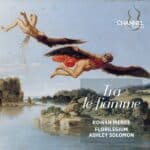
Tra le fiamme. Georg Friedrich Haendel (1685-1759) : Concerto grosso en sol majeur Op. 3 no 3 HWV 314. Tra le fiamme, cantate HWV 170. Antonio Vivaldi (1678-1741) : Concerto en sol majeur RV 84. Alleluia d’In Furore Iustissimae Irae RV 626. Johann Sebastian Bach (1685-1750) : Ich bin in mir vergnügt BWV 204. Rowan Pierce, soprano. Ashley Solomon, flûtes. Florilegium. Livret en anglais, français, allemand. Mars 2024. 63’58’’. Channel Classics CCS 47625

Concours La Maestra : la Slovène Mojca Lavrenčič remporte le premier prix

par

Organisé conjointement par le Paris Mozart Orchestra et la Philharmonie de Paris à l'initiative de Claire Gibault, le concours La Maestra, dédié aux cheffes d’orchestre, a dévoilé le samedi 28 février le palmarès de sa quatrième édition pour laquelle plus de 230 candidates issues de 50 pays avaient déposé leur dossier. Le jury, présidé par Oksana Liniv, a décerné le premier prix à la Slovène Mojca Lavrenčič.

L’histoire est belle : initialement première sur la liste d’attente, Mojca Lavrenčič remplaçait une candidate empêchée de participer pour des raisons indépendantes de sa volonté. Au fil des épreuves, elle s’est imposée avec une évidence croissante : technique solide, sens inné de la communication, vision globale de chaque partition, capacité d'aller toujours à l'essentiel. En revoyant les captations vidéo, on remarque ce sourire constant — invisible pour le public sur place, chaque cheffe dirigeant dos à la salle. Lors de la répétition de Fachwerk pour bayan, percussions et cordes de Sofia Goubaïdoulina, en demi-finale, elle ne cachait pas combien l’intensité du travail pouvait être éprouvante. Ce naturel, à mille lieues de la figure autoritaire et omnipotente encore dominante il y a quelques décennies, apparaît comme le signe d’un métier en profonde mutation — du moins peut-on l’espérer.

Ermonela Jaho and Donizetti: in search of the Truth

par

Our dialogue with Ermonela Jaho has been ongoing for many years, at least since 2021, when the great singer won the ICMA Award in the Vocal Music category with her recital Anima rara, released by the Opera Rara label. Despite the restrictions of the Covid period, she came to Vaduz for our gala and stunned the audience with a captivating performance of Violetta’s ‘Addio del passato’ (Goodbye to the Past). So much so that the jury unanimously decided to nominate her as Artist of the Year for the 2023 ICMA edition, held in Wroclaw. Ermonela has since become a sort of honorary member of the ICMA family: after the two interviews conducted for the aforementioned occasions,  Jury member Nicola Cattò (Musica) return to speak with the great Albanian soprano, who once again won first prize in the Vocal Music category with her recording of Donizetti’s melodies, with Carlo Rizzi on piano, again for Opera Rara.

How did you get involved in the Donizetti complete works project?
As you know, Opera Rara’s philosophy is to bring back forgotten works by great composers of the past: it was Roger Parker, in particular, who rediscovered these Donizetti romances, and he found more than 400 for different voice types. I immediately became passionate about the project because I feel at home with Opera Rara; I’m their ambassador: I’ve been working with them for a long time on the verismo repertoire, to which I now dedicate myself assiduously. At first, I was a bit skeptical about the quality of these works: they’re often very simple, they’re not the high-level Donizetti we find in the most famous operas, but the melody is there, the feeling is there, and it was right to make them known. We’re filling a gap in our knowledge of this composer. I’ve studied 42 of them, and I must say it was a lot of work. Most of them lack dynamic markings, and when the same melody has to be repeated three or four times on different texts, you have to constantly invent new details and expressive alternatives. Maestro Rizzi and I worked on this to give these pieces the dignity they deserve. There are romances in Venetian and Neapolitan, which are very entertaining and set to simple, popular texts, but also some derived from literary masterpieces like the Divine Comedy. Those in French, on the other hand, are more heartfelt, more intense, perhaps because they were created within literary and artistic circles, to whom Donizetti brought them as occasional gifts (as Roger Parker told me: this is why some are completely missing the piano parts, which we had to reconstruct). They have a certain melancholy, a pervasive sadness. I think these romances can be useful for young singers as an exercise: they are technically simple and help develop expressiveness and spoken singing, telling a story, however simple it may be.

When you do a complete recording, it’s inevitable that some pieces will be of lower quality: how do you deal with a score you don’t believe in?
It happens, it’s undeniable, that you sing songs that don’t resonate with you. In this case, the artist must idealize, must delve into their own subconscious, to make the audience believe that the value of the music is much greater than it actually is: they work hard on dynamics, on colors, because the human ear craves variety. In this way, they make the music more beautiful than it really is.

Many romances are in strophic form: did you add variations or embellishments?
Not many. The philosophy was to bring these romances to the public as they were written, with minimal changes. We worked, as I mentioned before, on the dynamics, which are used to vary pieces that can last over ten minutes: the idea was to tell a story as if we were speaking to children.

What’s the difference between the Italian and French ones?
The Italian ones are direct, unfiltered, even in the singing style; the French ones, on the other hand, have an intimate, internalized, delicate atmosphere. Less explosive, if I may say so.

What is your relationship with Donizetti’s theatre? You sang Maria Stuarda, Anna Bolena, Elisir, Don Pasquale…
True, I’ve encountered several of his works in my career: we know how prolific Donizetti was and how eventful his life was. But he was certainly a true genius, with a keen theatrical instinct, and his works display a clearly bravura quality. Donizetti’s coloratura, however, always has an expressive purpose. Donizetti’s theatre is complete, capturing every human nuance.
Résistance et dévotion : les sonates de guerre de Prokofiev par Giorgi Gigashvili

par

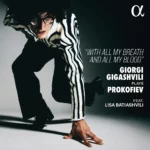
« With all my breath and all my blood ». Serge Prokofiev (1891-1953) : Sonates pour piano N° 6 op. 82, n° 7 op. 83 et n° 8 op. 84 ; Roméo et Juliette op. 64 : Danse des chevaliers, transcription pour violon et piano par David Grjunes. Joseph Bardanashvili (°1948) : To Gia Kancheli (P.S.), pour violon et piano. Giorgi Gigashvili, piano ; Lisa Batiashvili, violon. 2025. Notice en anglais, en français et en allemand. 84’ 41’’. Alpha 1194.

Faut-il transcrire pour le violon ?

par

Malgré un répertoire d’œuvres originales d’une grande richesse, les violonistes ont toujours cherché à l’enrichir de transcriptions en poussant les compositeurs à adapter des pages destinées à d’autres instruments (ou à la voix). Ça n’a pas toujours marché, mais il faut reconnaître que certaines de ces partitions revisitées se sont imposées au point d’en faire oublier les œuvres dont elles étaient issues.

Premier exemple, les Cinq Mélodies, op. 35a, de Prokofiev. Ces mélodies sont le fruit des relations entre Prokofiev et ses interprètes, la chanteuse Nina Koshetz, pour qui il composa la version chantée, et le violoniste Paul Kochański qui réalisa l’essentiel de l’arrangement pour violon et piano. Fut une époque où elles étaient l’apanage de David Oïstrakh ou Leonid Kogan. Les choses ont changé. Elles font maintenant partie du répertoire. Et on attendait un urtext que Henle a pu nous offrir, maintenant que Prokofiev est tombé dans le domaine public (mais attention, sa musique est encore protégée en France). À l’origine, cinq mélodies chantées ou plutôt cinq vocalises, sans paroles. Elles sont difficiles ces mélodies, la destinataire de l’œuvre se sent dépassée par certaines d’entre elles. Le violoniste Joseph Szigeti suggère à Prokofiev de les adapter au violon. Mais c’est Paul Kochański, le champion de la musique de Szymanowski, qui va s’en charger. Prokofiev procède à quelques modifications et Kochański en fait une musique spécifiquement écrite pour le violon. Prokofiev voulait lui en donner la paternité totale, mais finalement le nom de Kochański restera celui d’un arrangeur (comme pour les Six Chansons populaires espagnoles de Manuel de Falla). L’édition urtext de Henle, réalisée par Fabian Czolbe, repose sur la première édition.

Autre transcription de Prokofiev, sa Sonate pour violon et piano n°2, adaptation de la Sonate pour flûte et piano. C’est David Oïstrakh qui lui servit de guide pour passer de l’écriture pour flûte à celle destinée au violon. Dans le cas présent, les sources étaient nombreuses : Prokofiev était revenu en Russie et l’édition soviétique, qu’il l’a lui-même supervisée, est considérée comme la source la plus authentique. Viktoria Zora, l’éditrice du nouvel urtext chez Henle, a choisi de ne pas retenir une autre source très crédible, l’édition américaine réalisée sous la houlette de Joseph Szigeti, car Szigeti, bien que possédant une copie de l’original, avait procédé à de nombreuses modifications rythmiques ou dynamiques. D’autres éditions ont circulé après la mort de Prokofiev, plus ou moins authentiques. Un retour aux sources s’imposait. À noter que Henle offre la possibilité de consulter en ligne les doigtés et coups d’archet de David Oïstrakh et de Joseph Szigeti. Et les amateurs de comparaisons pourront se reporter à l’urtext de la version pour flûte que Henle vient également de publier.

Antonio Pappano on his new life with the London Symphony Orchestra – and what makes a good conductor

par

The London Symphony Orchestra’s record label LSO Live is Label of the Year at the International Classical Music Awards.  Kai Luehrs-Kaiser from the ICMA Jury member Das Orchester made the following interview with the LSO’s new Chief Conductor Antonio Pappano.

Mr. Pappano, for the first time in your career, you find yourself without an opera house. Do you like it?
I must admit, it’s a strange feeling. I’m used to going to an opera house every day and working there, in a very physical sense. My rhythm is completely different now. Without an opera house, and with a symphony orchestra instead, everything is much more hectic. I have to conduct different works all the time. Since I practice a lot and am used to preparing intensively, I feel as if I were still at university. On the other hand, my relationship with the Royal Opera House is still very good. We are in the middle of a new Ring with Barrie Kosky as director. And with the London Symphony Orchestra, I do operas in concert form.

Is the idea of a permanent opera house dead for you?
I am now 65 years old. I’m not sure I would have the desire and energy to embark on a new adventure. Well, the desire I probably have. After all, I did it for 35 years. The question is not entirely unexpected. All I can say is that I am and always will be, above all, a theater person.

With the London Symphony Orchestra, you have one of the most versatile and technically accomplished orchestras in the world at your disposal. Your best yet. Is there anything you need to prove – or want to prove – with this orchestra?
There always is. The LSO has a certain inner drive that is its calling card, so to speak. Nevertheless, I have to find the sound for the orchestra or adjust it as I see fit. I also have to make sure that we have the right persuasive power. No small responsibility! In Great Britain, all orchestras have the versatility you mentioned. That’s because of the system. It has developed a certain strength in these orchestras that is essential for their survival. The LSO embodies this in its most superior form. However, versatility can also be limiting. I admit that I have never done anything without conscientious and extensive rehearsals. Now I have to prove that I fit in with a system that is geared towards fewer rehearsals.

The principal conductors of the London Symphony Orchestra have included such illustrious names as Arthur Nikisch, Thomas Beecham, Pierre Monteux, and Claudio Abbado. Which of your predecessors do you admire most?
Oh, there were a few more. Colin Davis was one of the most influential conductors for 12 years. Claudio Abbado is remembered here as an enormous perfectionist. The musicians also rave about Valery Gergiev, who – despite all the chaos during rehearsals – must have conducted some of the most exciting concerts. Incidentally, even Edward Elgar was once the principal conductor of this orchestra. But the most important one for me is my immediate predecessor, Simon Rattle. He opened up the repertoire.

You know what Christoph von Dohnányi said at the Cleveland Orchestra: « When I conduct a good concert, George Szell gets the good reviews; when I conduct a bad one, I get the bad reviews. » Which of your predecessors do you fear the most?
I can’t even think about that.

Why not?
You always fear yourself the most. Because it’s all me, if I may say so. You can’t use any predecessor as an excuse, and you can’t let anyone else confuse you.

Every orchestra has gaps in its repertoire. Even the LSO?
Certainly. The LSO has undoubtedly performed all of Ralph Vaughan Williams’ symphonies at some point in its history. We are only now doing a cycle. For years, it was more likely that a Mahler or Shostakovich symphony would be included in the program than Vaughan Williams’ Ninth. You haven’t done the Bernstein symphonies in ages. Rossini would be important. Because he trains the fingertips, and that benefits classical music as well as the sense of esprit.

The LSO has reportedly made the most records of any orchestra, many of them during the André Previn era. Is that still worthwhile today?
That’s a question you’ll have to ask the management. For my part, I believe we have to do it. It documents the orchestra’s progress. If you choose the works well, recordings are still a meaningful and worthwhile endeavor today.

Which of your own recordings are you proud of?
All my recordings are fantastic. (Laughs loudly.) Well, I would actually mention the opera recordings I made with the LSO in the past: La Rondine, but also Werther, Trovatore, and parts of Trittico. Mostly with Angela Gheorghiu in the lead role. My favorite is Il tabarro with Maria Guleghina and Neil Shicoff. That was fantastic. I also like the recordings where I’m sitting at the piano, especially with Ian Bostridge. They’re important to me.

Valentin Malinin à la Fondation Louis Vuitton : un récit pianistique au cœur de Cage

par

Deuxième prix du Concours Tchaïkovski en 2023 et premier prix du French Riviera Masters en 2025, Valentin Malinin demeure encore peu connu en France. La Fondation Louis Vuitton a pourtant eu l’heureuse idée de lui confier un programme en miroir avec les six toiles intitulées Cage, présentées dans l’exposition Gerhard Richter visible jusqu’au 2 mars.

Intitulé « Music of changes », le récital s’articule autour de cinq œuvres de John Cage — Metamorphosis (1938), Quest (1935), The Perilous Night (1944), Ophelia (1946) et In a Landscape (1948). Deux pièces d’Henry Cowell s’y ajoutent, ainsi que Countertrend, composition du pianiste donnée en création mondiale, et une œuvre de Karina Baras, sa professeure de composition.

Concert Kurtág : Ascendance

par

C’est le premier, et ce sera sans doute le seul géant de cette génération à passer le centenaire de son vivant. György Kurtág est toujours là, et, après Xenakis, Boulez, Berio, il est mis à l’honneur dans ce concert de l’ensemble Intercontemporain. 


Avoir 20 ans en 1945 ! Une génération de compositeurs toujours aussi fascinante, celle dont la jeunesse créative a éclaté avec la table rase. Celle qui a pu légitimement s’octroyer la conviction que le renouvellement total du langage musical était enclenché de manière durable. La tonalité est morte, construisons sur du neuf!

Si Kurtág  n’en était pas spécialement un des représentants les plus radicaux (et les plus joués surtout), il en fait bel et bien partie. Certainement un des plus discrets de tous, il tardera à s’imposer, et l’adoubement de sa musique sera surtout marqué dans les années 80. Kurtàg est lui-même un interprète hors pair, il n’y a qu’à savourer les hypnotiques films vidéo où on le voit jouer avec son épouse, deux merveilleux nonagénaires et leurs 4 mains entrelacées. Extraordinaire transmetteur et professeur; Il y gagnera l’amour du public, et de ses interprètes par la chaleur, l’humanité et la subtilité de ses œuvres.

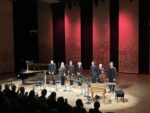
On pouvait alors imaginer plus de concerts, plus de moyens, plus d’interprètes, ou une plus grande jauge pour un tel événement. Peut-être même que le fait d’être vivant eut été paradoxalement un frein à quelque chose de plus grande envergure, mais pour un créateur aussi subtil, peut-être ne vaut-il pas mieux tout simplement un hommage de qualité. Et c’est vraiment ici, par le défi magnifique des 7 interprètes qui se présentent à nous sur scène ce soir, que le miracle a eu lieu: construire un récital comme s’il s’agissait d’une œuvre, et profiter du florilège illimité de pièces brèves du compositeur pour fabriquer un parcours en forme de triptyque narratif. 

Car György Kurtág est un tailleur de petits diamants, il mobilise le spectateur sur un temps court, en disposant des objets sonores sur un petit cadre temporel. Comme on reste sans voix devant un tableau de Miró, on est sensible au sens de l’équilibre immédiat et instinctif dans la répartition des tailles, des durées entre les différents objets sonores. 

Consonance, dissonance, densité tonale ou atonale, rythme complexe ou régularité extrême, Kurtág se joue des injonctions esthétiques. Il recommence l’histoire du langage musical à chaque début de pièce.  

Et si cet esprit libre et indépendant était une spécificité hongroise ? C’est en tout cas ce que semble vouloir montrer avec succès la savante répartition des petites pièces tout au long de ce concert. Nous y entendrons alternativement Kurtág, Liszt, Kodàly, Ligeti et Bartók. 

Comme une ronde des desserts, les 7 interprètes enchaînent sans pause ces miniatures (ou plutôt « microludes » dirait Kurtag, qui aimait bien inventer des termes). Liszt jouxte ainsi Kurtág et Kodàly, avec une unité mystérieuse et déconcertante. Les différences de langage ne représentant ici qu’un détail, les compositeurs hongrois nous offrent la cohérence en unissant liberté et raffinement. 

La silhouette élancée de Sébastien Vichard commence avec les glissandi troublants du perpetuum mobile. Játékok est un jeu, bien sûr, mais joué en grand maître et grand sérieux, il en devient danse, numéro d’illusionniste, démonstration de mime. Les arrangements pour alto, clarinette et cymbalum de Joan Magrané Figuera (Odile Aubouin à l’alto, Alain Billard à la clarinette et Aurélien Gignoux, cymbalum) intègrent Liszt dans le monde de Kurtág jusque dans leur silence. Renaud Déjardin prend la parole en quintes telluriques dans la sonate pour violoncelle seul de Kodàly, chacun a son rôle d’alchimiste et prend sa place avec naturel et légèreté.