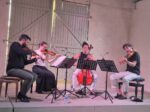
Terre de festivals, la France ne se délimite toutefois pas exclusivement au sud comme en témoignent les nombreuses manifestations culturelles se déployant dans l’ouest et, plus précisément, dans ce triangle formé par les départements limitrophes (49, 37, 79 et 86) des grandes régions Centre, Pays de la Loire et Nouvelle Aquitaine. Nouveau venu, l’Airvault Allegro Festival en est à sa deuxième saison.
L’excellent chef d’orchestre et pianiste George Petrou, par ailleurs directeur artistique de l’ensemble Armonia Atenea, est littéralement tombé amoureux de ce coin de pays. Sa carrière internationale a trouvé un splendide port d’attache dans la petite ville d’Airvault, dans le département des Deux-Sèvres, depuis qu’il a trouvé avec son épouse un ravissant château néogothique du XIXe siècle, qu’ils transforment peu à peu en un véritable centre musical. C’est dans la grange attenante à leur propriété que le couple a créé ces rencontres musicales avec des musiciens amis venus de partout.
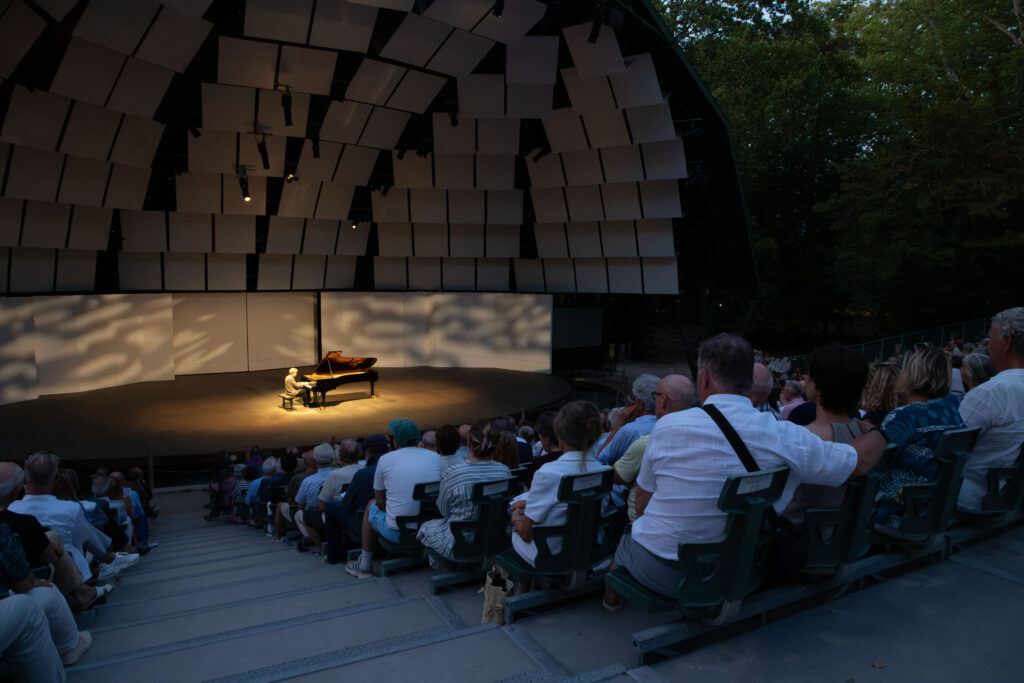
Le programme de cette deuxième édition est ambitieux avec huit concerts donnés par une petite vingtaine de musiciens venus de toute l’Europe dans un programme d’une extrême variété allant de Enoch Arden, mélodrame peu connu de Richard Strauss au concert final consacré à Johann Sebastian Bach qui aura lieu le 15 août dans l’église abbatiale Saint-Pierre d’Airvault, joyau de l’architecture romane du Haut-Poitou, avec son somptueux narthex et ses chapiteaux historiés. Récitals de piano, musique de chambre, chant et piano se suivent au gré de thématiques contrastées.
Fondé il y a une quinzaine d’années par le claveciniste et organiste Stéphane Béchy, le festival de la Dive Musique essaime dans les environs de Seuilly et de la maison natale de Rabelais, aux confins de la Touraine et de l’Anjou. Affluent du Thouet, la Dive prend sa source dans le département de la Vienne avant de cheminer tranquillement dans les Deux-Sèvres et dans le Maine et Loire. Domestiquée à partir du XVIIe siècle, la Dive fut dotée d’un vaste réseau de circulation fluviale pour le transport de farines, de céréales et de vin dès l’Ancien Régime. Le projet ne fut jamais rentable et l’arrivée du chemin de fer lui donna le coup de grâce. Mais le titre de ce beau festival est évidemment une allusion discrète à la « dive bouteille », expression inventée par le truculent Rabelais en 1546 autour du personnage de Panurge, ce joyeux luron amateur de bonne chère et des vins exquis (à boire avec modération) qui forment aujourd’hui encore un des nombreux agréments de cette riche région.
Repris depuis cette année par la violoniste Stéphanie-Marie Degand, avec l’appui de Patrice Franchet d’Espèrey, ancien écuyer du Cadre noir de Saumur et grand amateur de musique, le festival de la Dive musique prend une belle envolée. C’est la mélodie française qui ouvrait les feux de la programmation 2026 avec un splendide récital donné par le baryton Jean-Gabriel Saint Martin et la pianiste Elsa Lambert autour de la figure de Francis Poulenc, Tourangeau d’adoption qui possédait une superbe maison de maître à Noizay dans les environs d’Amboise.
Intelligemment conçu autour d’un choix de mélodies composées dans la région par Poulenc, ce concert d’ouverture avait pour cadre le beau manoir de la Grand’Cour, à Seuilly, mis à disposition du festival par son propriétaire anglo-américain cultivé et généreux, à quelques encablures du village natal de Rabelais et du beau château du Coudray-Montpensier qui fut la propriété de l’écrivain belge Maurice Maeterlinck, puis de l’avionneur Latécoère.
Le concert de clôture au Palais Princier affiche complet. Il s'agit du dernier concert dirigé par Kazuki Yamada en tant que directeur artistique et musical de l'Orchestre Philharmonique de Monte-Carlo. Une soirée forcément particulière, qui prend, au fil du programme, des allures de fête autant que d'adieu.
Le concert s'ouvre par une curiosité : une transcription du Quatuor à cordes de Maurice Ravel pour bois, cuivres et diverses percussions — sans aucun instrument à cordes — réalisée par le compositeur et arrangeur italien Giancarlo Chiaramello.
Le Quatuor de Ravel est un chef-d'œuvre, une œuvre d'une perfection formelle et d'une subtilité de timbres qui paraissent indissociables de son écriture originale. Ravel fut par ailleurs un orchestrateur exceptionnel, capable de transformer les couleurs instrumentales sans jamais perdre la substance de sa musique. Pour La Valse, il travailla simultanément aux versions pour piano, pour deux pianos et pour orchestre — trois réalisations musicalement indépendantes.
Giancarlo Chiaramello connaît, lui aussi, parfaitement l'art de l'arrangement. Il a notamment signé les arrangements de tous les concerts Pavarotti & Friends, expérience qui témoigne d'une solide maîtrise de l'écriture orchestrale et des possibilités offertes par les différents pupitres.
La démarche n'en demeure pas moins surprenante. Entendre les fameux pizzicati du deuxième mouvement du Quatuor transposés aux bois, aux cuivres et aux percussions constitue certes une expérience insolite. Mais cette curiosité sonore peine à convaincre sur le plan musical. Ce qui, chez Ravel, naît d'un équilibre extrêmement subtil entre quatre instruments à cordes — de leurs attaques, de leurs résonances et de leur complémentarité — perd ici une part importante de son évidence et de sa finesse.
La virtuosité de l'arrangement est indéniable, mais elle ne suffit pas à faire oublier ce que l'œuvre originale doit précisément à son écriture pour cordes. La transcription apparaît davantage comme un exercice de style que comme une nécessité musicale. L'Orchestre ne joue d'ailleurs que les deux premiers mouvements — vraisemblablement pour des raisons de minutage —, laissant une impression d'inachevé. Le public accueille cette proposition avec des réactions partagées.
Heureusement, la suite du programme donne à la soirée une tout autre dimension.
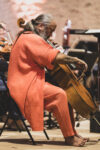
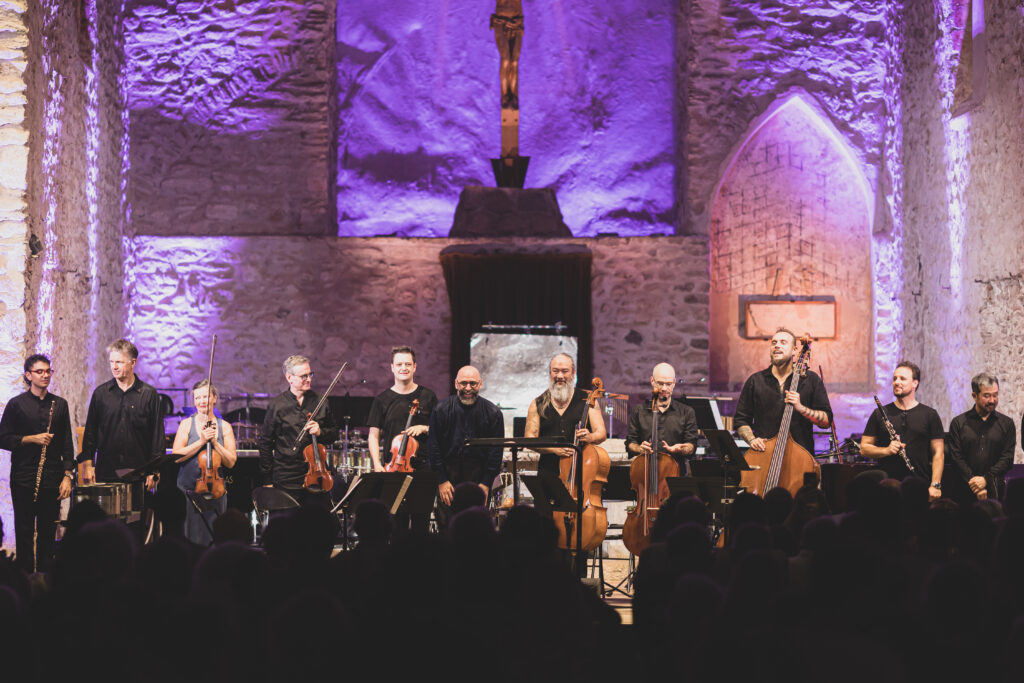
Pour sa première venue à Prades, l'Ensemble Intercontemporain, qui fête cette année son cinquantenaire, rend hommage au fondateur du festival pyrénéen, Pablo Casals, né il y a tout juste cent cinquante ans, et à l'instrument dont il fut l'un des plus grands interprètes au XXe siècle, avec la commande d'un concerto pour violoncelle à Arnulf Herrmann. Créée quelques jours plus tôt au Festival Messiaen, la partition de Vor uns liegen wunderschöne Tage (De beaux jours devant nous), défendue avec une saisissante intensité par Éric-Maria Couturier, pieds nus, vêtu d'un orange bouddhique inhabituel dans les salles, rompt avec le clivage concertant légué par la tradition, pour tisser une osmose entre soliste et orchestre, jusque dans l'évolution organique des textures. Cette succession de variations aux allures de passacaille, qui, réinventant une conception héritée du sérialisme, s'étendent à tous les paramètres du son, développe, au-delà de chatoiements que n'aurait pas reniés l'auteur de la Turangalîla-Symphonie, une sensibilité à la fois éclectique et personnelle, nourrie par l'originalité syncrétique de Ligeti, la vitalité d'Adams et la propulsion cinématographique de Bernard Herrmann. L'élasticité des associations de timbres et des tempi, glissant vers des parenthèses extatiques, façonne une fascinante immersion évocatrice, magnifiée par une complicité communicative entre les pupitres, dans l'acoustique ample de l'Abbaye Saint-Michel-de-Cuxa.
En ouverture de concert, At First Light, page de jeunesse pour petit orchestre que George Benjamin avait écrite à seulement vingt-deux ans, et donnée pour la première fois, en 1983, dans la grande salle du Centre Pompidou par le London Sinfonietta, tamise déjà l'atmosphère suggestive de l'ensemble de la soirée. Inspirée par les nuées picturales de Turner, qui font ressortir, dans une approche anticipant l'impressionnisme, la lumière avant le paysage, la pièce déploie une maîtrise précoce de la palette orchestrale, de sa pâte et de ses alliages de couleurs. Sous la direction attentive de Pierre Bleuse, les combinaisons instrumentales dépassent leur apparente dimension chambriste, dans des contrastes entre plages contemplatives et éclairs puissants qui diffractent l'espace sonore. Cette condensation par la quintessence musicale de la perception picturale, que l'on peut qualifier d'intellectuelle, est révélée avec un pinceau sûr.
Il y a une image que l'on retient de Simon Rattle : la crinière, le sourire, le geste souple, l'air d'un homme qui explique autant qu'il dirige. Et il y en a une autre, plus discrète, qui dit peut-être davantage : celle d'une salle de concert sortie de terre à Birmingham en 1991, Symphony Hall, parce qu'un chef de trente-six ans avait décidé que son orchestre méritait un écrin à sa mesure. Entre ces deux images tient tout le personnage. Car ce que Rattle a construit au fil de quarante ans de carrière, ce ne sont pas d'abord des interprétations. C'est une fonction. Il a redéfini ce qu'est un directeur musical — et, ce faisant, il a fait mourir une certaine idée du métier pour en installer une autre.
Le prince
Pour mesurer la rupture, il faut se rappeler ce que Rattle a trouvé en héritage. Le directeur musical, tel que le XXe siècle l'avait sacralisé, était un prince. De Toscanini à Furtwängler, de Karajan à Solti, la fonction se résumait à deux gestes souverains : incarner un son et régner sur un répertoire. Le chef était un demi-dieu, une verticalité, une signature. La radio, le disque puis l'image avaient forgé ce mythe et l'avaient porté à l'incandescence : Karajan, metteur en scène de sa propre légende, en fut l'aboutissement autant que la caricature. Le prince ne rendait de comptes à personne ; sa seule mission était d'être grand.
C'est cette figure que Rattle allait rendre caduque. Non par polémique — il n'a jamais théorisé une quelconque mise à mort — mais par un simple déplacement du centre de gravité.
Le laboratoire de Birmingham
On situe volontiers la révolution Rattle à Berlin. C'est une erreur de perspective. La révolution s'est faite en province, au City of Birmingham Symphony Orchestra, où il resta dix-huit ans, de 1980 à 1998. Presque une vie. C'est là, loin des projecteurs et des attentes écrasantes des grandes maisons, qu'il disposa d'une liberté que seule une institution secondaire pouvait offrir : celle de se tromper, d'expérimenter, de construire.
Et ce qu'il construit là, paradoxalement, ressemble d'abord au plus classique des modèles. Rattle prend un orchestre régional respectable et en fait, sur la durée, un ensemble de rang mondial — le geste même d'un Ormandy à Philadelphie ou d'un Mravinski à Leningrad. Il s'ancre dans une ville, épouse une communauté, obtient en 1991 la construction de Symphony Hall, alors l'une des meilleures salles d'Europe. Et il forge son identité artistique au fil d'une longue série discographique chez EMI, comme on bâtissait autrefois une réputation : disque après disque, patiemment. Ses cycles Sibelius et Mahler, son Szymanowski, son Britten, cette Turangalîla de Messiaen gravée dès 1987 avec Peter Donohoe et restée une référence — c'est sur le vinyle puis le CD que se construit, à l'ancienne, la légitimité de l'orchestre et de son chef. À première vue, voici un héritier fidèle du modèle Karajan, un prince de plus, simplement plus jeune et plus souriant.
Mais regardons de plus près ce répertoire, et le renversement affleure déjà. Car ce que Rattle bâtit à Birmingham n'est pas seulement un orchestre : c'est un laboratoire du XXe siècle. Là où le prince entretenait un canon, lui en fabrique un nouveau. Le contemporain n'est pas chez lui un supplément d'âme, une pièce brève qu'on glisse en début de programme avant les choses sérieuses : c'est la matière même de son projet. Il va jusqu'à doter la ville d'un instrument sur mesure : en 1987, il est le patron fondateur du Birmingham Contemporary Music Group, phalange de chambre née du CBSO et vouée à la seule création — plus de cent cinquante œuvres nouvelles à son actif —, sur le modèle de l'Ensemble intercontemporain que Boulez avait fondé à Paris une décennie plus tôt. Il fait de Messiaen un compositeur de grand répertoire, porte la musique de Hans Werner Henze — dont il grave la Septième Symphonie et la Barcarola —, installe Mark-Anthony Turnage comme premier compositeur en résidence de l'orchestre (1989-1993), et crée en 1997, à Symphony Hall, Asyla d'un Thomas Adès de vingt-six ans. Ce geste-là dit tout : cinq ans plus tard, pour son premier concert de directeur musical du Philharmonique de Berlin, Rattle choisira précisément d'ouvrir avec Asyla, avant la Cinquième de Mahler. La découverte provinciale portée au sommet, comme un manifeste.
Cinquième volet de notre série d'été sur les compositeurs que l'histoire officielle n'a pas retenus.
On aimerait, pour expliquer un oubli, pouvoir invoquer la marge : l'autodidacte tenu à l'écart, l'étranger sans réseau, le provincial que Paris n'a jamais reçu. Avec Alain Bancquart (1934-2022), rien de tout cela ne fonctionne. Voilà un homme qui fut alto solo de l'Orchestre National de France, attaché à l'admnistration des orchestres de la radio publique, inspecteur de la musique au ministère de la Culture (où il fit naître le Centre de documentation de la musique contemporaine et la collection Musique française d'aujourd'hui), producteur à Radio France et professeur de composition au Conservatoire de Paris. Le cœur de l'institution française, pas sa périphérie. Et pourtant sa musique, à sa mort en janvier 2022, s'est éteinte dans un silence presque parfait. Le paradoxe est là, et il est vertigineux : jamais un homme aussi intérieur au système n'aura été aussi exilé par son propre art. Ce qui l'a rendu inaudible, ce n'est pas son statut. C'est sa langue — la microtonalité, cette musique des intervalles plus petits que le demi-ton, que notre monde sonore ne sait tout simplement pas jouer.
Un parcours français
Né à Dieppe en 1934, Bancquart fait au Conservatoire de Paris un parcours de pur produit de la maison : violon, alto, musique de chambre, contrepoint, fugue, et la composition auprès de Darius Milhaud et de Louis Saguer. De 1961 à 1973, il est alto solo de l'Orchestre National — un homme d'orchestre avant d'être un homme de bureau, ce qui comptera. Puis vient la trajectoire institutionnelle — mais sur le versant administratif, pas sur le podium : directeur musical, c'est-à-dire responsable au sein de la radio publique, des orchestres régionaux de l'ORTF (1973-1976), puis de l'Orchestre National lui-même (1976-1977) — jamais chef titulaire, fonction qui revenait alors à Martinon puis à Maazel. Il est enfin inspecteur de la musique au ministère (1977-1984), poste depuis lequel il suscite la création du Centre de documentation de la musique contemporaine et de la collection Musique française d'aujourd'hui.
Mais derrière le haut fonctionnaire se cachait un compositeur radical. Dès 1967, et de sa propre initiative, Bancquart engage l'ensemble de son écriture dans l'étude des micro-intervalles, des modes défectifs et des « espaces non octaviants » — ces échelles qui refusent jusqu'au repère le plus élémentaire, l'octave. Le Thrène I de 1968 est sa première œuvre en quarts de ton ; il descendra plus tard jusqu'aux seizièmes de ton. Autant dire qu'il a choisi, très tôt et seul, la voie la plus escarpée qui soit.
La rencontre qui scellera ce choix vient après, non avant. Producteur à Radio France de l'émission Perspectives du XXe siècle, Bancquart y croise le vieil Ivan Wyschnegradsky — Russe de Paris, hermétique et pauvre, l'un des pionniers absolus du quart de ton, qui avait passé sa vie à composer pour des pianos accordés autrement, dans une obscurité quasi totale. Bancquart ne lui doit pas sa vocation, déjà engagée depuis une décennie : il reconnaît en lui un prédécesseur et un frère de solitude, dont l'exemple approfondit et légitime sa propre recherche. Hériter de Wyschnegradsky, c'était recevoir une passion — et, avec elle, une malédiction : celle d'une musique que notre monde sonore n'est pas équipé pour entendre.
Un maître d'institution
Ce qui rend le cas Bancquart si troublant, c'est qu'il n'a rien du reclus. Là où Wyschnegradsky s'était muré dans sa solitude, lui a bâti, transmis, théorisé. Au Conservatoire de Paris, à partir de 1984, il refonde la classe de composition ; il y installe un séminaire « Nouveaux Intervalles », véritable tentative d'institutionnaliser l'enseignement de la microtonalité au cœur de la maison la plus centrale du système français. Il laisse aussi un testament théorique, Musique : habiter le temps (2003), somme d'un compositeur qui pensait sa pratique autant qu'il l'exerçait.
Et il y a, dans toute son œuvre, un dialogue : celui avec la poète Marie-Claire Bancquart, son épouse, dont les textes irriguent la plupart de ses cycles vocaux. On a donc affaire à un créateur entouré, marié à la littérature, adossé aux plus grandes maisons, entièrement dévoué à la transmission. Tout, sauf la figure de l'oublié — sauf le résultat.
Il est des récitals qui marquent un moment dans l’histoire de l’interprétation. Celui donné jeudi soir à La Roque d’Anthéron par Alexander Malofeev relève de cette lignée. A la fois par son époustouflante maîtrise technique, son extrême maturité musicale et l’audace de sa conception. Une conquête de l’inassouvi pensée comme un long voyage à travers le temps et l’espace.
A la conquête du non-dit
Urgence de l’attaque de l’allegro assai des « Klavierstücke D946 », silence et reprise du thème dans une maturité inquiète et puis surprise d’un chant rentré qui suspend le temps et reprise du thème initial plus assuré. L’allegretto révèle une esquisse de mélodie perpétuelle qui tourne sur elle-même, ensuite bousculée par d’inévitables à-coup. Une fois de plus une inquiétude s’installe et la reprise devient questionnement. Même mélange d’un envol retenu, d’un retour sur soi et d’une conclusion en forme d’échappatoire dans l’allegro final. Il y a décidément quelque chose d’inabouti dans ce D 946 qui semble ouvrir la porte aux grands développements des trois ultimes sonates sans jamais aller au fond des choses comme s’il lançait des pistes que le compositeur approfondira dans d’autres œuvres.
Cet inachèvement, un principe très schubertien, demeure sans doute le ressort de tout ce programme apparemment étrange proposé avec un tact millimétré par Alexander Malofeev. Comme si chaque pièce contenait un retour, plus naturel, sur elle-même au travers de débordements inattendus. Le pianiste russe enchaîne alors les cinq mouvements de danse de la « Suite Holberg » de Grieg comme un salut formel au passé , il nous entraîne plus loin avec une plongée dans les mystères de la nature dans « Les Arbres » de Sibelius culminant dans un sensationnel « Le sapin ». Moirée dans la sensation trouble de sonorités magiques, la « Valse en la bémol op.38 » de Scriabine atteint alors un sommet expressif dans le principe de la quête inaboutie là où dans leur urgence presque névrotique, les « Préludes » d’Arthur Lourié semblent annoncer l’arrivée d’une inévitable conclusion. Elle surgira avec un panache fou, ivre de sonorité dans une 2e sonate de Rachmaninov, à la fois flamboyante et inquiète comme si aucune des pistes lancées tout au long de ses trois mouvements ne devaient vraiment aboutir pleinement. On se dit alors que les trois mouvements chahutés de cette page puissante renvoient à ceux, plus mesurés, des « Klavierstücke » qui ouvraient le programme. Le parcours est bouclé : l’inassouvi conserve ses mystères en dépit de la maestria avec laquelle il a été défendu. La réponse appartient à l’auditeur que ce prodigieux pianiste de 25 ans a provoqué, avec subtilité mais en profondeur.
Il peut alors s’abandonner dans ses bis : un élégant Ground de Purcell, une rugissante « Toccata » de Prokofiev et une torride « Valse » de Griboyevdov.
Depuis vingt ans, l’Ensemble Aedes s’impose comme l’un des acteurs du renouveau choral en France. Son chef et fondateur Mathieu Romano revient sur la naissance de l’ensemble, ses choix artistiques et les clés d’une aventure musicale singulière.
Les origines de l’aventure et les premiers défis
L’Ensemble Aedes célèbre cette année ses vingt ans d’existence. Avant cet anniversaire, revenons aux origines. Quel a été votre parcours avant la création d’Aedes ?
J’ai commencé très jeune par la flûte traversière, qui a été mon premier métier. J’ai aussi étudié le piano pendant mon enfance à l’École de musique d’Auxerre. Vers 15-16 ans, j’ai découvert la direction de chœur grâce à une classe de mon conservatoire. Bien que je ne sois pas issu d’une famille de musiciens, mes parents m’ont toujours encouragé. Je suis ensuite entré au CNSM de Paris en flûte, où j’ai suivi les cours d’István-Zsolt Nagy et participé à plusieurs masterclasses. J’ai joué notamment avec l’Orchestre de Paris et l’Orchestre de Massy, avant de me consacrer à la direction de chœur. À la fin de mes études, j’ai intégré la classe de direction d’orchestre.
Comment est née l’idée de fonder Aedes ?
Très naturellement : j’avais une formation de chef de chœur, mais pas d’ensemble à diriger. L’année où j’ai réussi le concours d’entrée au CNSM, j’ai décidé de créer Aedes avec des amis. J’écoutais beaucoup de chœurs en France et en Europe, mais aucun ne correspondait vraiment à ce que je recherchais. Je me suis dit : « Puisque rien ne me satisfait complètement, autant créer le mien ! » Nous avons réuni quelques amis et commencé à travailler ensemble.
Quels ont été les principaux défis des débuts ?
Nous avons eu la chance de créer Aedes à une douzaine, tous très jeunes. Je n’avais pas encore 21 ans et les autres avaient entre 16 et 25 ans. Nous étions tous étudiants et n’avions pas encore besoin de vivre de la musique. Cela nous a permis de privilégier la qualité musicale plutôt que les contraintes économiques. C’était avant tout une aventure entre amis, avec l’envie de faire de la musique au plus haut niveau. Dès le départ, l’un des chanteurs m’a épaulé sur les aspects techniques, administratifs et organisationnels. Nous avons longtemps fonctionné en binôme, bénévolement. Les difficultés sont venues plus tard, avec la professionnalisation et la recherche de financements. Mais cette aventure fondée sur l’amitié a posé des bases solides, ce qui explique sans doute pourquoi les débuts n’ont pas été si difficiles.
Certainement s'agit-il de l'ultime série pour la mise en scène de Tcherniakov, créée in situ en 2021. Portée par un tandem Grigorian/Brownlee stellaire, on ne pouvait rêver mieux comme distribution finale.
« Rien n'a fait faire à Wagner de réflexion plus profonde que la rédemption : l'opéra de Wagner, c'est l'opéra de la rédemption. Il y a toujours chez lui quelqu'un qui veut être sauvé : tantôt un homme, tantôt une femme — c'est là son problème. Et avec quelle richesse il varie ce leitmotiv ! Cruelles échappées rares et profondes ! Qui donc nous l'apprendrait, si ce n'est Wagner, que l'innocence sauve avec prédilection des pécheurs intéressants ? (C'est le cas du Tannhäuser.) Ou bien que le Juif errant lui-même trouve son salut, devient casanier lorsqu'il se marie ? (C'est le cas du Vaisseau fantôme.) Ou bien qu'une vieille femme corrompue préfère être sauvée par de chastes jeunes gens ? (C'est le cas de Kundry dans Parsifal.) », déclarait Nietzsche dans Le Cas Wagner.
Le Vaisseau fantôme est certes le premier opéra dit « de maturité » de Wagner, mais c'est également celui dans lequel il instaure le concept central de la quasi-totalité de ses livrets : la rédemption. On y suit un homme maudit, condamné à une errance éternelle dont il ne pourra être libéré que par une femme qui lui sera fidèle jusqu'à la mort. Toutefois, pour sa mise en scène, Dmitri Tcherniakov place la malédiction sous un prisme diamétralement opposé : celui de la vengeance d'un homme contre la communauté ayant poussé sa mère au suicide.
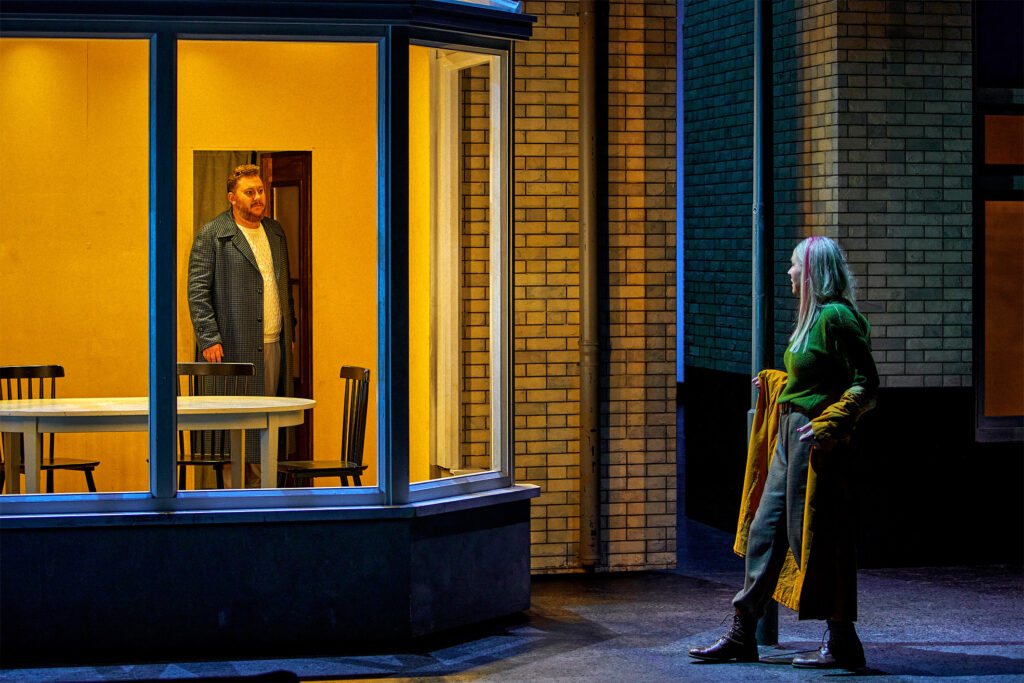
L'ouverture a ici davantage des allures de séquence d'exposition et l'on se retrouve plongé dans un anonyme village norvégien, composé d'une huitaine de bâtiments qui se mouvront sur la scène pour structurer différents endroits. Passée l'ouverture, l'action se déroulera plusieurs années après, et le drame humain relaté suit globalement le gros du mythe fantastique évoqué dans le livret — si l'on fait abstraction de l'unité de lieu nouvellement ajoutée — jusqu'à l'ultime scène du troisième acte, qui prendra in fine des allures de massacre de la population par des hommes du Hollandais, avant que ce dernier ne soit lui-même abattu par Mary.
Dans le rôle-titre, rarement aura-t-on vu un Hollandais avec pareille présence scénique, singulièrement ténébreuse. Nicholas Brownlee n'a pas encore commencé à chanter que son intensité dramatique mange déjà la scène, avant de tutoyer de nouveaux sommets, portée par une intelligence de la déclamation particulièrement remarquée. Le vibrato, bien présent, vient sertir une tessiture dramatique parfaitement modulée pour le lieu. On note également une gestion remarquable des crescendos dans les phrases longues, ainsi que des extrêmes graves de tessiture somptueux.